What You’ll Learn
|
You’ve probably published a page, waited a month, and watched it sit on page 3. That’s usually not a content problem. It’s an on page SEO factors problem, and most of it is fixable in an afternoon.
This guide simplifies the on page SEO factors that really matter in 2026. We’ve grouped them by content, HTML, and technical setup so you know exactly what are the on page seo factors to fix first.
The Quick Answer
On page SEO factors are the elements you directly control on your webpage, such as headings, content, and page speed. These help search engines and AI understand your content so they can rank it higher. By optimizing these, you can improve your rankings without needing new backlinks, but if you neglect them, even great content may struggle to be found.
Here’s a quick reality check before you start fixing anything.
- A 2025 industry analysis found that pages with a keyword in the title tag see higher click-through rates than pages without one.
- Recent research from Search Engine Journal confirms that for effective on page seo factors, Google now prioritizes content quality and E-E-A-T over simple keyword density.
- A 2025 Core Web Vitals study found that pages loading under 2.5 seconds retain significantly more mobile visitors than slower pages.
- Ahrefs data shows that about 90% of pages get no traffic from Google, usually because the content is thin or poorly organized.
- A schema markup study found that pages with structured data are more likely to appear in rich results and AI-generated answers.
That last stat matters more than it used to. AI search engines now read your page in passages, not paragraphs, so structure isn’t optional anymore.
What Are the Important On Page SEO Factors, Grouped by What They Control?
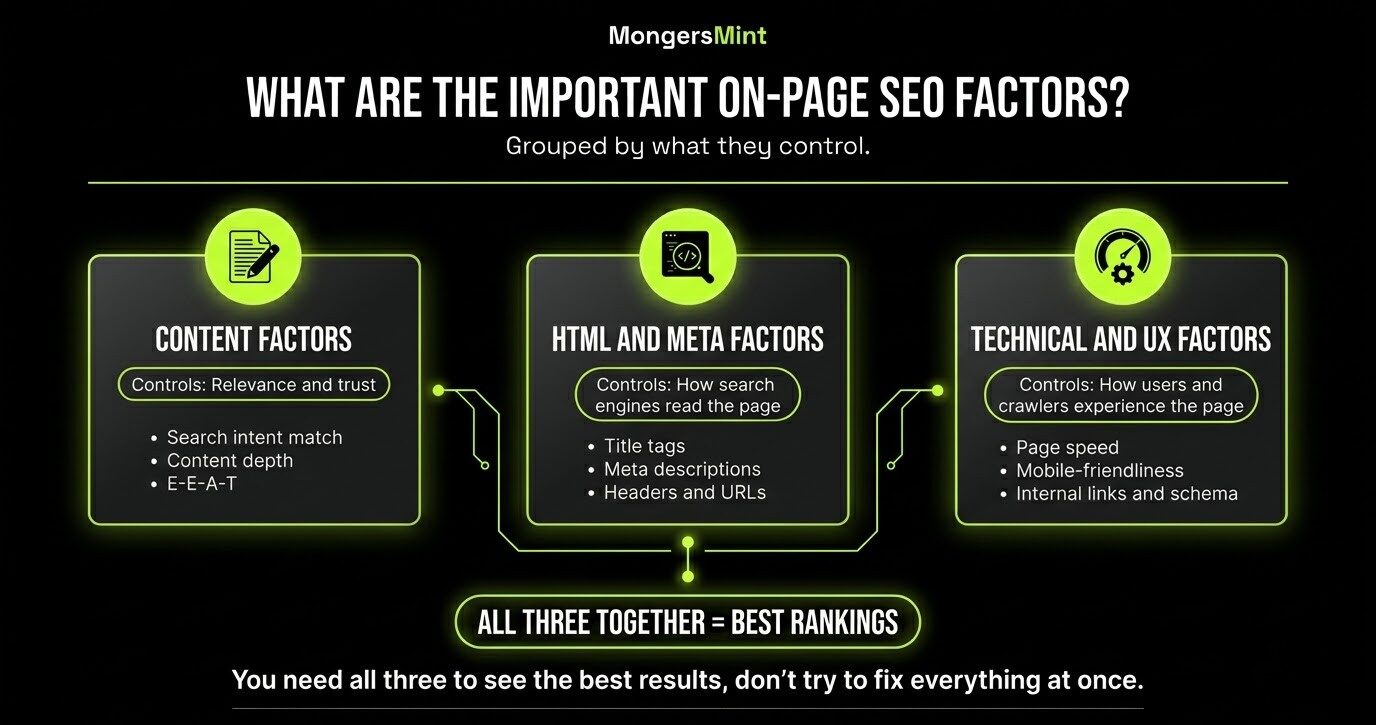
Don’t try to fix everything at once; that’s the fastest way to get stuck. Instead, group your tasks to make the process easier.
| Category | What It Controls | Examples |
| Content Factors | Relevance and trust | Search intent match, content depth, E-E-A-T |
| HTML and Meta Factors | How search engines read the page | Title tags, meta descriptions, headers, URLs |
| Technical and UX Factors | How users and crawlers experience the page | Page speed, mobile-friendliness, internal links, schema |
These categories work together to boost your rankings. You need all three to see the best results.
Content Factors That Decide Whether Google Trusts Your Page IN 2026?
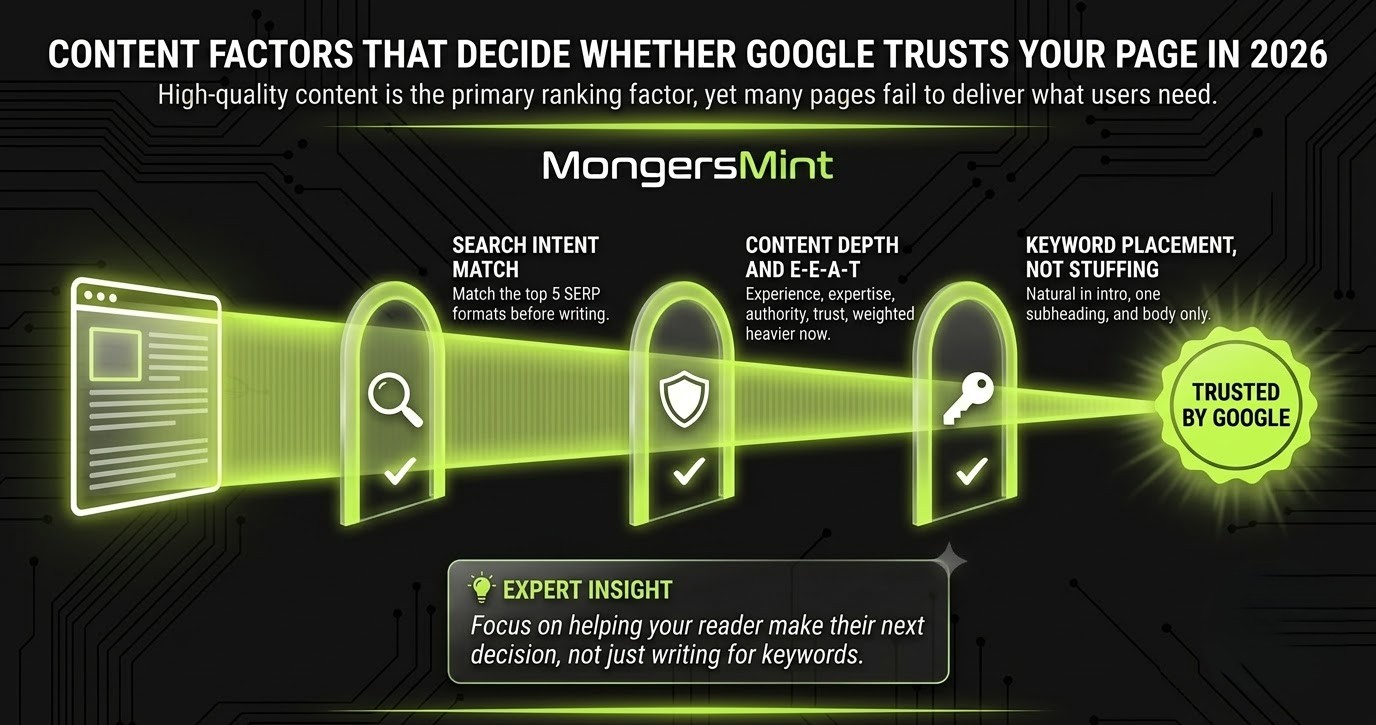
High-quality content is the primary factor for search rankings, yet many pages struggle to deliver what users actually need.
Search Intent Match
If a user searches for “on page seo factors” wanting a quick list but finds a 400-word history of search engines, they will leave. Before writing, check the top 5 results to ensure your format matches what users and Google expect.
High bounce rates quickly signal to Google that your content isn’t answering the user’s question.
Content Depth and E-E-A-T
Google’s Search Quality Rater Guidelines weigh experience, expertise, authority, and trust more heavily than they did a few years back. Thin, generic content rarely competes here anymore.
| 💡 Expert Insight—”Focus on helping your reader make their next decision rather than just writing for keywords. Share unique insights to build trust instead of just repeating standard definitions.” |
Keyword Placement, Not Keyword Stuffing
Place your on page SEO factors naturally in your intro, at least one subheading, and throughout the main text. Avoid forcing them too often; overusing keywords hurts readability and will not improve your rankings.
HTML and Meta Factors That Help Search Engines Read Your Page in 2026
Your content could be excellent and still underperform if the HTML around it is a mess. This is the part crawlers read before they read a single sentence.
Title Tags and Meta Descriptions
Your meta title is the first thing Google and readers see. Make it a headline under 60 characters and include the on page SEO factors keyword. While meta descriptions don’t directly change rankings, they are key for getting clicks. Write a description that promises specific value rather than just repeating your title.
Header Tag Structure (H1 Through H6)
Header tags are a quick win. Use one H1 for your main title. Use H2 tags for your main sections, and H3 tags to break those sections down into smaller, readable points.
- H1: one per page, keyword near the start
- H2: main sections, title case, descriptive
- H3: sub-points inside a longer H2
URL Structure
Keep URLs short, readable, and keyword-focused rather than long and complex. A clean URL like /on-page-seo-factors/ helps both search engines and visitors understand what your page is about before they even click.
Get this layer right, and you’ve made the page easy to read. The next layer decides whether people actually stick around once they land.
Technical and User Experience Factors That Affect Rankings in 2026
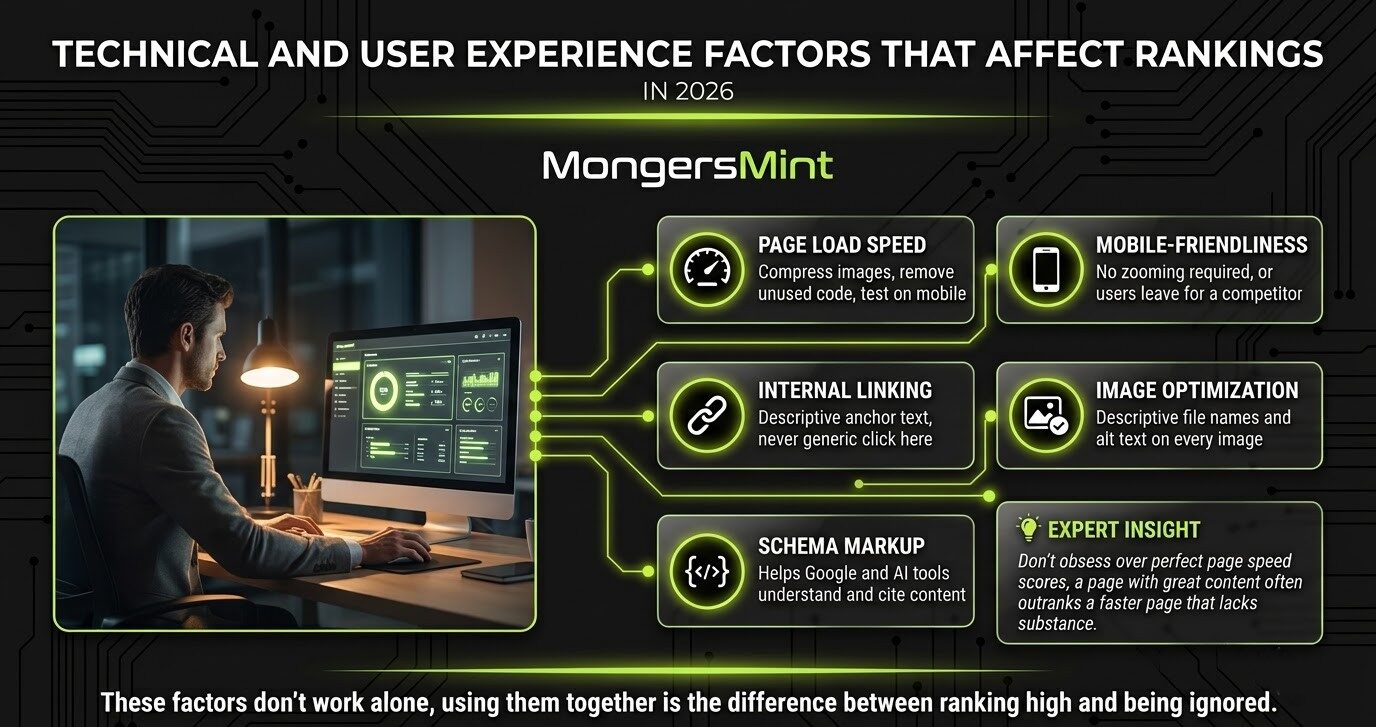
Many content teams overlook this category, yet it often limits the performance of your other SEO efforts. Focusing on these technical factors is essential to ensure your hard work pays off.
Page Load Speed
Slow pages drive visitors away instantly. Improve speed by compressing images, removing unused code, and testing on a mobile device to ensure it performs well for real users.
Mobile-Friendliness
Most of your mobile traffic comes from phones. If users have to zoom in to read your content, they will likely leave for a competitor, and Google will notice
Internal Linking
Internal links show search engines your site’s hierarchy and keep readers engaged by leading them to related content. Always use descriptive anchor text that explains where the link goes, and avoid generic phrases like “click here.”
Image Optimization
Every image needs a descriptive file name and image alt text that describes what’s actually in it. This helps accessibility and image search and gives crawlers one more relevance signal.
Schema Markup
Structured data helps Google and AI search tools better understand and cite your content, even if it doesn’t guarantee a rich result.
| 💡 Expert Insight—” Don’t obsess over perfect page speed scores. Google’s Core Web Vitals are relative to your industry, so focus on quality first. A page with great content will often outrank a faster page that lacks substance.” |
These factors don’t work alone. Using them together is the difference between ranking high and being ignored.
How to Prioritise On Page SEO Factors When You Don’t Have Time for Everything in 2026?
You don’t need to fix all 13 factors at once. This table helps you focus on the 20% of tasks that deliver 80% of the results, allowing you to make a significant impact even with limited time.
| Priority | Factor | Typical Time to Fix |
| Fix This Week | Title tags, meta descriptions, header structure | 2–4 hours |
| Fix This Month | Content depth, search intent match, internal links | 1–2 weeks |
| Fix This Quarter | Page speed, schema markup, site-wide mobile audit | 3–6 weeks |
Start with title tags and headers. They’re the fastest wins, and they don’t require touching your codebase.
Tracking Whether Your On Page SEO Factors Actually Worked in 2026?
Don’t guess if your efforts are working; measure your results instead. Use metrics like organic clicks and average position to see what truly drives growth and focus your time where it matters most.
| Metric | What It Tells You | Where to Check |
| Organic clicks | Whether your title/meta changes improved CTR | Search Console |
| Average position | Whether content and structure changes moved rankings | Search Console |
| Bounce rate | Whether the page matches search intent | Analytics |
Set a 30-day check-in. On page SEO factors show results faster than link building, but they still need a few weeks of crawling and re-indexing to register.
| When tracking many client pages, a dashboard is much faster than spreadsheets. MongersMint connects your organic performance data directly to your existing lead and campaign reports. This lets you see the impact of your SEO work instantly, instead of digging through separate tools. |
Getting Your On Page SEO Factors Right in 2026
On page SEO factors aren’t a one-time checklist, they’re maintenance you revisit every time you publish or update a page. Start with title tags, headers, and content that actually matches what the searcher wants. Layer in the technical fixes once the fast wins are live.
Success in 2026 isn’t about keyword stuffing. It’s about creating content that people trust, and AI can easily cite. Choose three factors from this guide and improve them today.
Frequently Asked Questions
Q1. What Are The Most Important On Page SEO Factors To Fix First?
Honestly? Title tags, meta descriptions, and header tags. They're the fastest wins on this whole list. No dev help needed, no CMS migration, just an afternoon and a checklist. Start there before you touch anything technical.
Q2. How Many On Page SEO Factors Should I Actually Track?
Fewer than most guides make it seem. We cover 13 here, split across content, HTML, and technical work. Past that, you're probably tracking things that don't move the needle much.
Q3. Does Keyword Density Still Matter For On Page SEO Factors?
Not the way it used to, no. Google leans on content quality and search intent match now. Stuff the keyword in, and you'll probably hurt readability more than you help rankings. Natural placement wins.
Q4. What Is The Difference Between On Page SEO Factors And Technical SEO?
On page factors live directly on the page, your content, title tags, headers. Technical SEO is the backend stuff: crawlability, indexing, and site architecture. Different layers, same goal.
Q5. How Long Does It Take to See Results From On Page SEO Factors?
A few weeks, usually. Google has to recrawl the page and reindex it before any change shows up in rankings. Give it 30 days minimum before deciding something didn't work.