What You’ll Learn
- The difference between Technical SEO vs on-page SEO, the true one (not textbook)
- A table that can be used to compare side by side with an explanation to your team
- What’s the best one to work on when time or money constraints are an issue?
- The actual effects of bad business orders on traffic
- A 5-step process to audit them both, rather than one
You have come to a standstill in your rankings. You’ve published content. You’ve created a couple of links. Nothing’s moving.
You do some research on Google, and then you see two terms that may sound related, but aren’t exactly the same: technical seo vs on page seo. Which of them is defective? Maybe both. Probably both.
Here’s the short version. Technical SEO is if Google can actually find, crawl and display your website. On page SEO is if the content truly addresses what someone entered into the search bar. One’s invisible plumbing. The other is the object your reader views. If he or she skips either, the other one will be unable to do its job.
What Is The Real Difference Between Technical SEO And On-Page SEO in 2026?
Technical SEO deals with crawlability, site speed, mobile friendliness, indexation and structured data basically, anything that occurs before a human ever views your page. On-page SEO focuses on the keywords, meta tags, headings, content quality and internal links that the reader is reading and clicking on.
Simply put, technical SEO is the answer to the question “Can Google crawl it? Technical SEO is basically the answer to the question: Can Google crawl it? On page optimization is the answer to the question “Is this page worthy of ranking when it arrives at the website? Without one, the other is meaningless.
One digital marketing case study was of a client who had great product copy, but half of the catalogue was blocked by the robots.txt file by accident. Zero rankings. Very good writing that Google can’t see. In one sentence: technical seo vs on page seo – Content is no good if the crawler doesn’t come to the door.
Technical SEO vs On-Page SEO: A Complete Comparison in 2026
Let’s get the comparison most people are looking for before we dig in deeper.
Table 1: Technical SEO vs On-Page SEO Overview:
| Factor | Technical SEO | On-Page SEO |
| Focus | The infrastructure, crawling, and indexing of a site. | The content, keywords, meta tags and structure. |
| Who Sees It | Search engine crawlers | Users vs. search engines. |
| Common Fixes | Site speed, XML sitemap, schema markup are three additional areas that can be optimised. | Use headings, keywords and internal linking. |
| Typical Fix Time | Changes are indexed in 2-8 weeks | 4-12 weeks for ranking movers. |
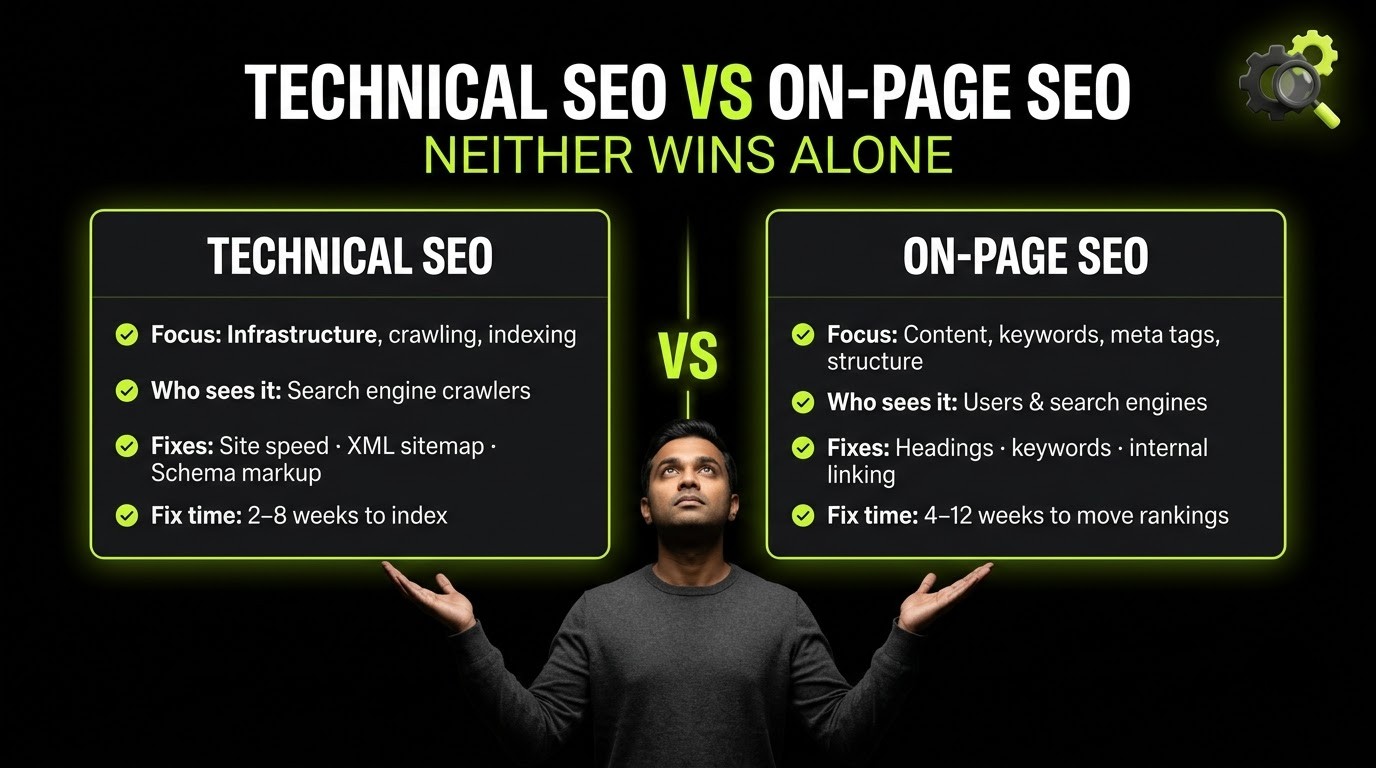
While you’re at it, check out this comparison of Technical SEO vs On-Page SEO.
Each column is a winning column by itself. If a site is technically perfect, but has little content, it suffers just as quickly as a site with great content that can’t be found by the crawler.
So What Exactly is Technical SEO and Why is it Important?
There’s no way to make a page rank if Google can’t see it. This is all the reason to begin here.
Crawlability And Indexation
If you have a site that is not crawlable, then the search engine won’t be able to get around your site. This involves having a functional XML sitemap, a properly set-up robots.txt file and clean URL structures. For months, bad crawl budgets are robbing large sites of entire sections without anyone realising the extent of the losses.
Site Speed And Core Web Vitals
Google has three metrics for measuring site speed: Largest Contentful Paint, Interaction to Next Paint, and Cumulative Layout Shift. You will lose points on your technical SEO if you miss any of the three, not just theoretically, but really. According to site speed analysis, pages taking less than 1 second to load achieve average conversion rates as high as 40% and by the 3-second mark, they have an average conversion rate of about 29%.
Structured Data And Schema Markup
Schema markup provides search engines with a lot of information about a page, product, article, faq, review, etc. before they need to guess. It’s also now the foundation of how AI Overviews and chatbots grab answers, making it even more relevant now than it was two years ago from now.
A bad technical layer first costs all subsequent dollars of content less than desired.
💡 Expert Insight: “Everyone thinks of crawl budget as a large site issue, and it is not. A 40-page local business site can be a crawl budget leak if half of those pages aren’t linked to each other, either internally or from other pages on the site. Crawl budget waste goes up as fast as it goes down.
What On-Page SEO Covers And Why Content Still Needs To Convert?
Before you start to focus on advanced on-page optimization strategies, you should first understand what on page optimization is and why content is still the key to conversions.
The content is not written as the pipes get fixed. Enter in on page SEO.
Ultimately, Keywords, Meta Tags and the Quality of the Content.
“Decoration” is not the word for title tags, meta descriptions, or header structure. They’re the initial impression a searcher will receive prior to reading your content quality. Even if it is only a small difference, one with the exact search term still has the advantage of a title tag with the term.
Search Intent Matching
No matter how elegant the content may be, it’s destined to fail when it’s not crafted for the right search intent. When a searcher types in “best SEO agency,” they want to see comparisons. This person is searching for “what is on page SEO”.This person is looking for a definition of what is on page SEO. When it comes to the wrong intent and bounce rate, it takes care of the rest.
Informational: The reader wants to know something
Commercial: The reader is looking at information before purchasing a product or service.
Transactional: The reader is in action mode.
Internal Linking Structure
There are two things that internal linking can do: it can drive visitors deeper into your site, and it can inform search engines of which pages are more important. For practical purposes, a page with no internal links to it is orphaned.
The technical foundation under the content layer can finally be ranked when the content layer is right.
Technical SEO Vs On-Page SEO: Which Should You Prioritise First? Experts Guide
When it comes to optimising your website, you have a choice between technical SEO and on-page SEO. There’s a choice between the technical SEO vs on page SEO.
If you’re only able to do one fix this month, then do technical SEO. The decision breakdown is as follows:
This Table lists the disciplines in question and the time periods that are most crucial for focusing on them.
| Situation | Prioritize | Why |
| New site, zero rankings | Technical SEO | Nothing ranks if crawlers can’t index it |
| Rankings stuck on page 2-3 | On-Page SEO | Content may not match intent well enough |
| Traffic dropped after redesign | Technical SEO | Likely broke crawl paths or speed |
| High traffic, low conversions | On-Page SEO | Content isn’t answering the right query |
💡 Expert Insight — “Most teams will want a technical first answer, always. If they suddenly see a traffic drop in an established site that has good content on it, most likely the drop is because of a bad redirect, a blocked directory, or a broken canonical. Check the logs first; don’t touch the copy first.
The truth is that it’s not such a race between technical seo vs on page seo. It’s a sequence. Address the foundations and feed them content that is worthy of ranking.
What Happens When You Get The Order Wrong in SEO Implementation?
One ecommerce client had a 4,000-page catalogue, and even though they were putting new content on the website every week, they didn’t have any traffic. The diagnosis: Largest Content Paint took 4.8 seconds to load on 47% of the product pages for which we couldn’t find a robots.txt blocking them, and there was no schema markup anywhere on the site.
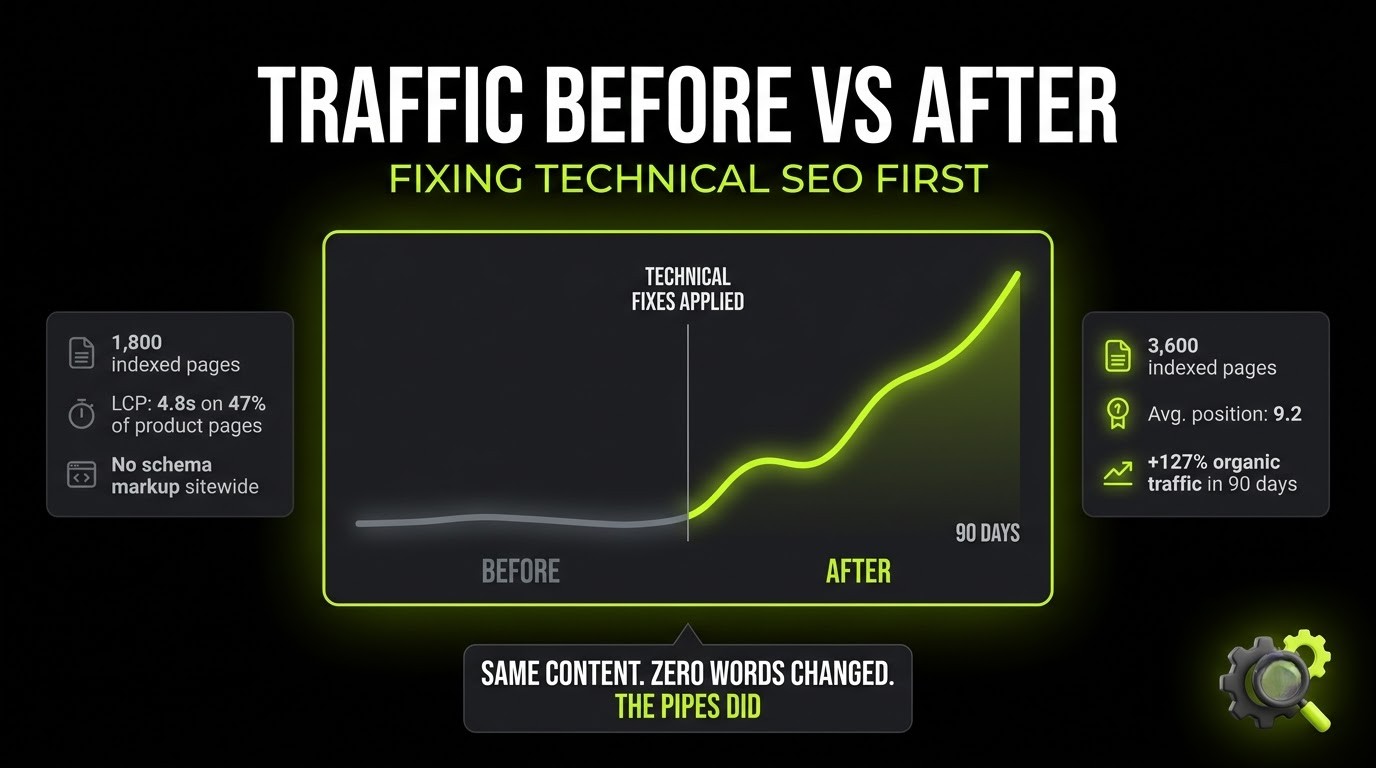
In this Before/After, you’ll find the traffic before and after implementing technical SEO first.
First of all, the technical problems that needed to be solved were addressed, and indexed pages increased from 1800 to 3600, and average position was pushed to 9.2 in 90 days. In the same period, there was an increase of 127% in organic traffic.
No rewrite was done of any of that content. There were no changes in words. The pipes did.
How to Audit Technical SEO as Well as On-Page SEO Together in 2026? Experts Guide
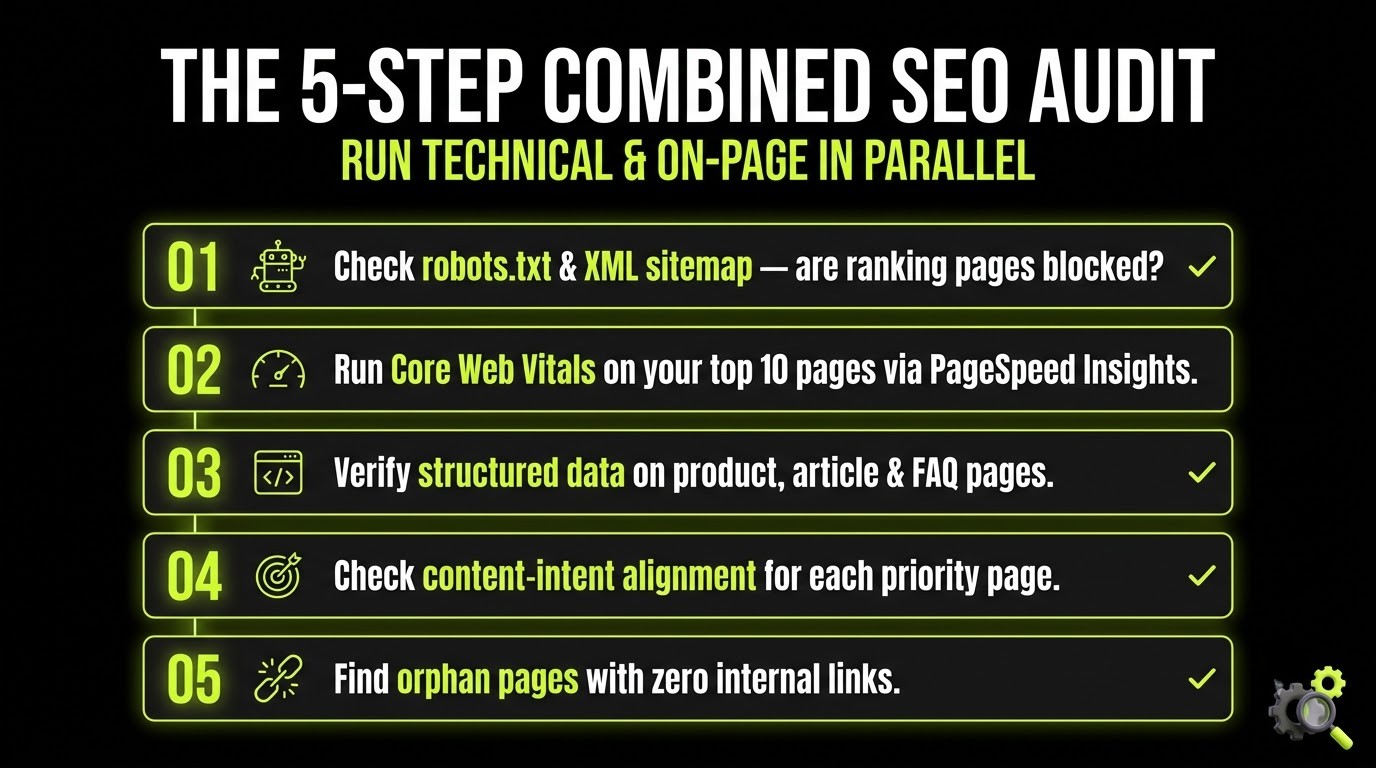
Don’t consider them as independent projects. Run them in parallel, in the following order:
- Check the robots.txt file and XML sitemap to see if they are blocking pages worthy of ranking; crawl check
- Run Core Web Vitals on your top 10 pages using PageSpeed Insights and check the speed on your core pages.
- Schema check: Check that the structured data is present on product, article or FAQ pages.
- Content and intent check: Make sure each priority page is content aligned with the intent behind the target keyword.
- Internal link check: Identify pages that have no internal links to them (also known as orphan pages)
Combined Audit Timeline Table
| Step | Tool | Typical Time |
| Crawl and speed check | Search Console, PageSpeed Insights | 1 to 2 days |
| Schema and content audit | Manual review or crawler tool | 3 to 5 days |
| Internal link mapping | Site crawler export | 1 to 2 days |
By doing these 5 steps all together, rather than standalone, each quarter, you’re closer to the end of the gap between technical and on page SEO in a much quicker time.
MongersMint’s SEO Services team carry out technical and on-page audits concurrently instead of serially, where real time is normally saved. This platform will identify crawl issues, Core Web Vitals problems and content gaps in a single dashboard, which means that no items are in a queue waiting for ‘the SEO person’ to get to them. It can save an audit week or more for teams with a tight hand that need to balance both disciplines. Discover MongersMint’s SEO Services to gain insight into how it works end-to-end.
Technical SEO Or On-Page SEO: What To Fix This Week?
Technical seo vs on page seo was never about two competitors; it was about the two types of seo. It is an order of operations! Before all else, crawlability, speed and schema; if Google can’t get to the page, then what? Next, it’s time to optimise keywords, intent match and internal links, as those are the factors that will keep visitors on the page.
This week: First, run the crawl check. The quickest of the five steps, and often the most significant wins make themselves known. Make sure that pages are not blocked or missing a schema; if they are, correct them before working on any sentence of copy.
FAQ (Frequently Asked Questions)
Is Technical SEO Or On-Page SEO More Important?
Technical Seo Or On Page Seo both of them are not more important. Technical SEO is the factor that puts a page within reach. Once it has been ranked, on page SEO is worth it! The site is not performing well despite its strengths in one and weaknesses in the other.
How Long Does It Take To See Results From Technical SEO Fixes ?
Indexing improvements from technical SEO fixes typically show up in 2 to 8 weeks, depending on crawl frequency. Ranking movement from content changes usually takes longer, closer to 4 to 12 weeks.
Can I Do On-Page SEO Without Fixing Technical SEO First ?
You can, but the content likely won't rank as well as it could. If crawlers can't properly index or render the page, even well-optimized content struggles to show up in results.
Do I Need A Developer For Technical SEO ?
Some tasks, like sitemap generation or basic meta robots settings, don't require developer access. Deeper fixes like Core Web Vitals optimization or server configuration usually do.
How Often Should I Audit Technical SEO Vs On-Page SEO?
Run a full technical audit quarterly, and check on-page elements monthly for your top-performing pages. Search Console monitoring in between catches most issues before they become expensive.