In this guide, you’ll learn about
|
Your ads are up and running. Your website is now published. However, the calls are not coming as expected, or when they do, half of them don’t return the call after the initial one. This is the truth for most businesses seeking to expand online in today’s day and age. The issue is not that digital marketing is not effective. What’s the issue is that most businesses are executing tactics without having a system. Clicks without capture. Traffic without follow-up. Leads without conversion.
This guide will take you through a fully functional and working method for how to generate leads in digital marketing, from the channels that work to the follow-up systems that convert leads into paying customers.
So What is Lead Generation in Digital Marketing in 2026?
Lead generation in digital marketing is the art of drawing in and capturing the interest of people who are genuinely interested in what you’re offering and then nurturing them into making a purchase via digital marketing methods such as search, social media, paid advertising, and email.
Lead: Someone who took an action indicating interest. They filled out a form. They’ve come to you through an ad that they’ve clicked. They sent you a WhatsApp message. That’s the beginning of a relationship.
In digital marketing, the idea of lead generation is to get that initial action to repeat, to be cost-effective, and to include contacts that will convert.
| Term | What It Means | Example |
| Lead | Someone who showed interest | Filled out a contact form |
| MQL (Marketing Qualified Lead) | Engaged but not ready to buy | Downloaded a guide |
| SQL (Sales Qualified Lead) | Ready for a sales conversation | Requested a demo or quote |
| Conversion Rate | % of leads that become customers | 15 out of 100 leads closed |
Table 1: provides a quick reference to some of the most important terms associated with lead generation.
The kind of lead you receive is totally dependent on the channel, message, and follow-up you’re using. Which leads us to the part that most guides don’t talk about.
Why Do Most Lead Generation Campaigns Fail Before They Start?
You can spend ₹50,000 per month on Meta ads and not get any useful thing out of it. This occurs on a regular basis, and the reason is almost always the same: businesses are concerned with getting the leads, but not catching them.
The Follow-Up Problem
The 2025 study revealed that the average number of touchpoints required for most leads to become ready to buy is between 7 and 13.
Most businesses only go so far as 1 or 2. They send one WhatsApp message and wait for a response; if there is none, they move on. The lead did not go cold due to it being a bad lead. It cooled off simply because there was no follow-up.
The Traffic-Without-Conversion Problem
Organic traffic is great. However, traffic without a lead capture mechanism, a form, a CTA, a lead magnet, or a booking link is worth nothing. People come, and people go, and they never come back.
Wrong Channel for the Wrong Audience Problem
Using LinkedIn ads for a local coaching centre for class 10th? Wrong channel, wrong people, wasted money. The channel must match the buyer; it’s not negotiable.
| 💡 Expert Insight: The greatest conversion lever in lead generation in digital marketing isn’t your ad creative or your landing page. It’s your response time. Businesses that respond within 5 minutes of a lead form submission see a 9x higher contact rate than those that wait even an hour. [Context: Senior Digital Strategist / Based on 2025 industry data / MongersMint Campaign Data] |
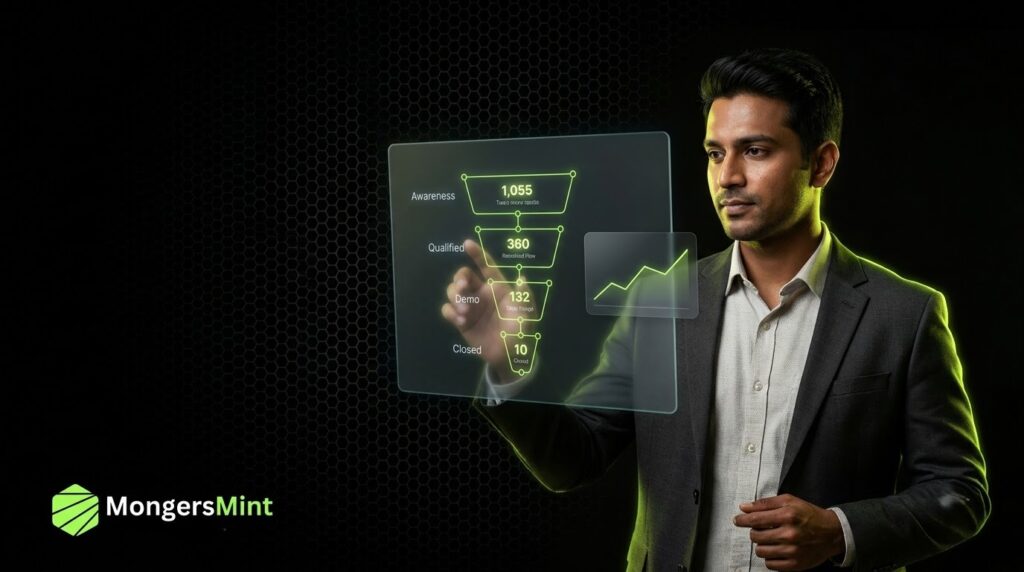
The Proven 4-Stage Digital Lead Generation Funnel For Businesses in 2026
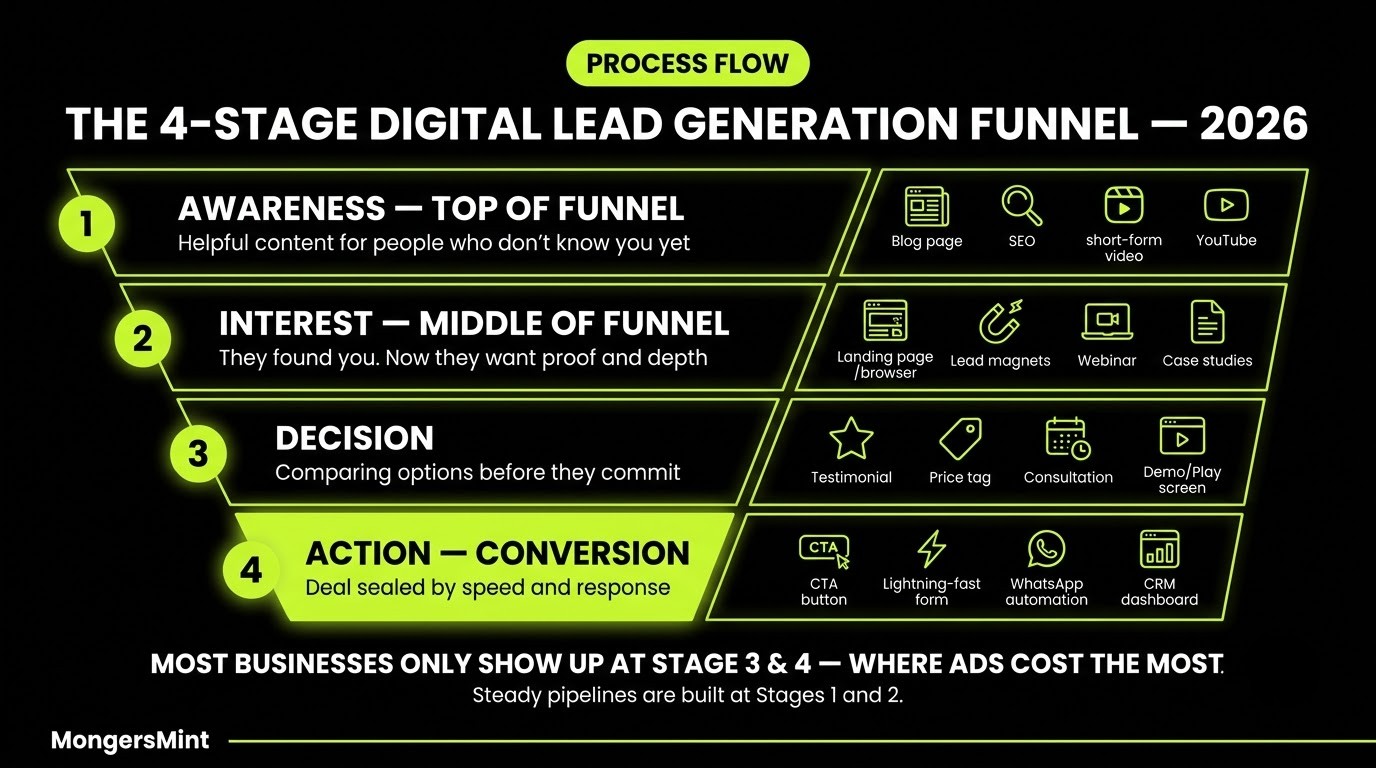
Prior to selecting your channels, know where each channel fits into the buyer’s journey. To understand how to generate leads in digital marketing, you need to know what stage you’re targeting.
Stage 1: Awareness (Top of Funnel)
The person is not familiar with you. They’re searching for answers, not solutions. You’re supposed to come up with content that is actually helpful. Example: Blog content, SEO, short-form video, social media posts, YouTube.
Stage 2: Is the interest (middle of the funnel) stage.
They’ve found you. Now they want to know more. That’s where landing page optimisation, lead magnets, webinars, and case studies come in.
Stage 3: Decision
They’re comparing options. Testimonials, price comparisons, free consultations, and demo offers propel them.
Stage 4: Action (Conversion)
They’re ready. The deal is sealed with a clear CTA, a fast-loading form, and a quick human response. This is where CRM for lead management and WhatsApp automation can save you from losing leads that you have already invested money in.
Most businesses only appear when the competition is high, and at stages 3 and 4, the cost of the ads is high. What sets businesses with a steady lead pipeline apart from those who are hunting for every lead is building a presence at Stages 1 and 2.
9 Proven Digital Marketing Lead Generating Strategies that Work in 2026
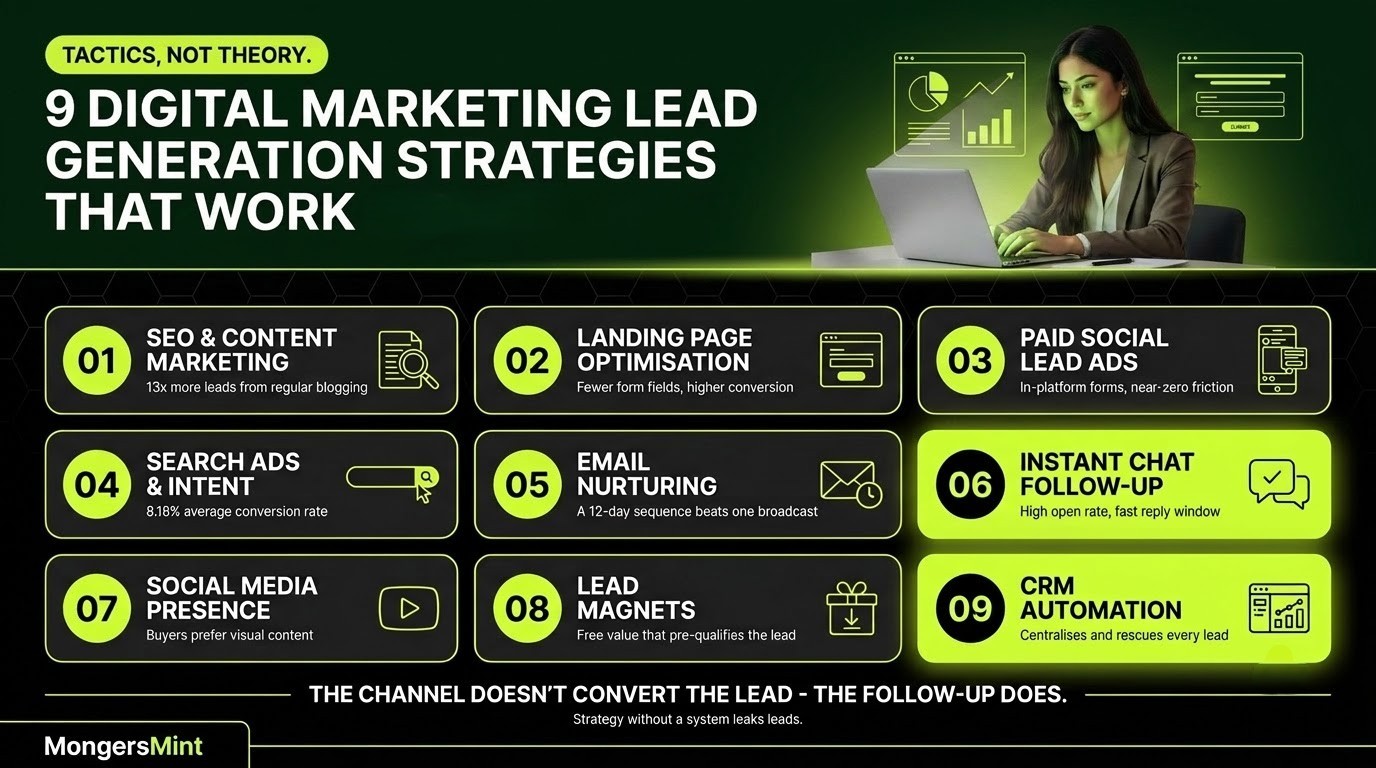
What is working now, not theory, but tactics that have actual converting logic behind them.
1. SEO and Content Marketing
- One key to generating leads in digital marketing via search is to simply answer the questions that your buyers are already asking Google.
- According to a recent report, companies that blog regularly are 13 times more likely to see leads. Although the cost of a single lead varies by industry, it is generally accepted that the average expense is $40.00.
- This is important because organic traffic builds up over time. The paid ad ceases to exist when you cease paying. A blog post that ranks on Page 1 continues to attract quality leads for months or years.
- In order for inbound marketing via SEO to function, your content must be exactly what searchers are looking for. Informational keywords (such as this one) require in-depth, organised responses. Commercial keywords require landing pages that have compelling CTAs.
Professional SEO services in India can be obtained from MongersMint.
2. Landing Page Optimisation
Each campaign requires a campaign landing page, not your home page.
Your homepage is for all. A landing page is for one person and one problem, and it provides one solution. That’s what dictates conversion rate.
A good landing page will do 4 things:
- Clearly states the offer in the headline
- Identifies 2-4 advantages (not features)
- Has a form of three or fewer fields (name, phone, one qualifying question)
- Fast loading time (less than 3 seconds) on mobile
Each extra form field can cost an average of 11% in conversions. Find the source link here → https://www.performoo.com/resources/blogs/digital-marketing-lead-generation
Reduce the form to the minimum. Then try out all the rest.
3. Meta Ads (Facebook and Instagram) for Lead Generation
Meta’s top ad product allows users to fill out a form within the platform. This is one of the quickest methods to run lead generation in digital marketing on a large scale due to the low friction and precise targeting.
Targeting options: Age, location, interests, job title, look-alikes of your existing customers, and website retargeting audiences.
What is working in 2026:
- A specific, benefit-oriented headline (“Get 30 Qualified Leads in 30 Days”, not “Digital Marketing Solutions”)
- Short video or carousel, demonstration of proof, not promise.
- A lead form containing only up to 3 fields.
- An immediate WhatsApp follow-up as soon as someone submits
One healthcare client, MongersMint, worked with them to reduce their cost per lead from ₹480 to ₹190 in 6 weeks, not by changing the ad creative, but by fixing the follow-up sequence and retargeting the warm audience properly.
Want to reach the right audience and generate more leads? With Meta Ads and our Meta Ads lead generation services, MongersMint can help you create targeted campaigns that turn ad spend into measurable results.
4. Google Ads and Search Intent
Meta gets the people who may be interested; Google gets the people who are looking.
Google paid search ads are optimised for people typing “buy” keywords at the moment. People in decision mode: ‘digital marketing agency Bengaluru,’ ‘best coaching classes near me,’ and ‘real estate marketing company.’
The best time to use Google Ads is when:
- The ad headline is matched to the exact keyword.
- The landing page is congruent with the ad’s message
- With negative keywords, you can eliminate irrelevant searches.
According to WordStream’s 2026 Google Ads benchmarks, the average conversion rate for Google Ads is 8.18%. However, performance varies significantly by industry, so businesses should compare their results with benchmarks for their specific sector.
5. Email Marketing and Lead Nurturing
Email marketing is one of the highest ROI to cost ratio of any other lead generation in digital marketing channels, but most businesses use it only to broadcast and not to nurture. A nurture sequence operates in the following way: somebody downloads a complimentary resource or registers for a webinar. They send a series of 4-6 emails over a period of 2 weeks that provide them real value, trust, and slowly lead them towards a consultation or purchase.
In fact, almost half of all marketers report that email is their most effective lead generation tactic. Source link here: https://bloggingwizard.com/lead-generation-statistics/
The proper order:
- Day 1 : Review + use the resource
- Day 2: A quick win (a little something they can do today)
- Day 4: Case Study/Result Story
- Day 6: Overcome the biggest objection
- Day 9: Soft offer (free consult, demo, trial)
- Last chance + urgent close on day 12
This is what lead nurturing does well. The lead was warm, and the leads were warmer.
6. WhatsApp Marketing & Instant Follow-Up
98% of people open WhatsApp. There are no other channels that can match this.
In India, WhatsApp can be the quickest way to lead-to-conversation. The first follow-up after someone fills out a form from a Meta ads campaign, a Google Ad, or an organic traffic blog post should go to their WhatsApp within 5 minutes.
A good WhatsApp marketing sequence consists of the following:
- Immediate response message (“Hi [Name], thanks for contacting MongersMint! Now what happens is this…”)
- One value message or case study 24 hours later
- Follow-up check-in after 48 hours (if no response)
- Day 5 re-engagement message
This straightforward workflow helps you to collect leads that you might be losing between form completion and your sales team’s initial outreach.
7. Social Media Lead Generation
Social platforms not only create awareness but, if configured properly, they can also attract leads directly.
The combination of connection requests + a value message sequence is effective on LinkedIn for B2B. Warm interest is driven by a strong organic content presence on Instagram and Facebook, and a landing page with a link-in-bio.
In 2026, the best format for inbound marketing audiences is short-form video (Reels, YouTube Shorts) without ads.
According to a 2025 report, 81% of B2B buyers prefer interactive or visual content over static text. Although the cost of a single lead varies by industry, it is generally accepted that the average expense is $40.00.
Post consistently. In captions, use strong CTAs. Respond to all comments and DMs within the first hour; this brings people into your funnel better than any paid ad.
8. Lead Magnets and Free Resources
A lead magnet is anything that is of value to a prospect, and they will give up their contact information in exchange for it.
If done right, lead magnets will be the cheapest lead capture tool you’ll have. They work because they pre-qualify the lead: if someone downloads a “50-Point Website SEO Audit Checklist,” he or she is almost certainly a business owner who is interested in the ranking of his/her website.
Here are some ideas for lead magnets that work:
- Free audit (SEO audit, ad account review, website speed test)
- Industry report/benchmark data
- Checklist or template
- A series of mini video courses (3-5 short videos)
- Free consultation or strategy call
The lead magnet should be something that’s directly related to the paid service you’re looking to sell. The closer the match is, the higher the lead quality.
9. CRM Automation and Lead Management
This is the one that brings all the others together and is the one that most businesses don’t have. CRM for lead management is where all leads from any source are centralised, tagged, automatically responded to, and put on a follow-up journey.
If you don’t have a CRM, then leads fall through the cracks. Salespeople don’t follow up. There are so many unanswered WhatsApp messages. Your advertising dollars are creating leads that aren’t converting.
If you have your CRM set up well:
- All new leads are followed up with an automatic WhatsApp and email.
- The sales pipeline reveals the location of each lead at a given time.
- Reporting dashboards will indicate which channel is delivering the highest quality leads.
- An AI voice call or automated SMS takes care of the first touch point, even after hours.
This is business automation in action, as a lead generation multiplier.
How to Do Lead Generation in Digital Marketing for Education Sector in 2026?
The buyer journey of the education sector is unique. A parent who is looking for a coaching centre for his/her child is not a B2B buyer. A student who is comparing an MBA program is different from someone who is signing up for a short online course. To understand how to generate leads in the education sector through digital marketing, it is essential to have a strategy that revolves around that behaviour.
Education lead generation is different for the following reasons:
The decision cycle is longer. Price is not the most important factor; trust is. And the audience is often a combination of the student (who wants it) and a parent or spouse (who pays for it).
A recent case study revealed that the integration of digital marketing strategies with timely follow-up systems enabled Webster University Geneva to achieve a 30% increase in enrollments. Higher education marketing strategies for 2025.
Successfully generating leads in the education space with digital marketing requires matching the channel, message, and follow-up to this buyer dynamic.
Education Lead Generation Channels That Work
The best-performing channels for students/parents are:
- Meta Ads (Facebook and Instagram): Parent audiences are on Facebook. Students are on Instagram. Creating separate campaigns with separate creatives for each will provide you with a much higher-quality lead than a single generic campaign.
- Google Ads: Searches such as “best NEET coaching in Bengaluru” or “digital marketing course online” are queries that are ready to purchase. Use a dedicated landing page to capture them and a CTA to provide a free demo class or counselling call.
These are the types of questions that parents and students always ask:
SEO and content marketing: “Is [course name] worth it in 2026?” “Top engineering colleges in [city]”, “best MBA programs for working professionals.” For them, ranking means that they get organic traffic that converts better than paid, as it’s research-level intent.
In the education space, the initial WhatsApp message in the 10 minutes after the inquiry is the key conversion moment, which is known as the following:
- WhatsApp nurturing: Following this, a 5-step program over 7 days (course information, faculty introduction, past results, FAQs, and a free trial session) sees a conversion rate that is much higher than a single sales call.
- Webinars and virtual demos: A live session with a faculty or counsellor member, promoted through Meta ads and e-mail, leads to high-intent leads at very low cost per lead. The webinar itself is the lead for you.
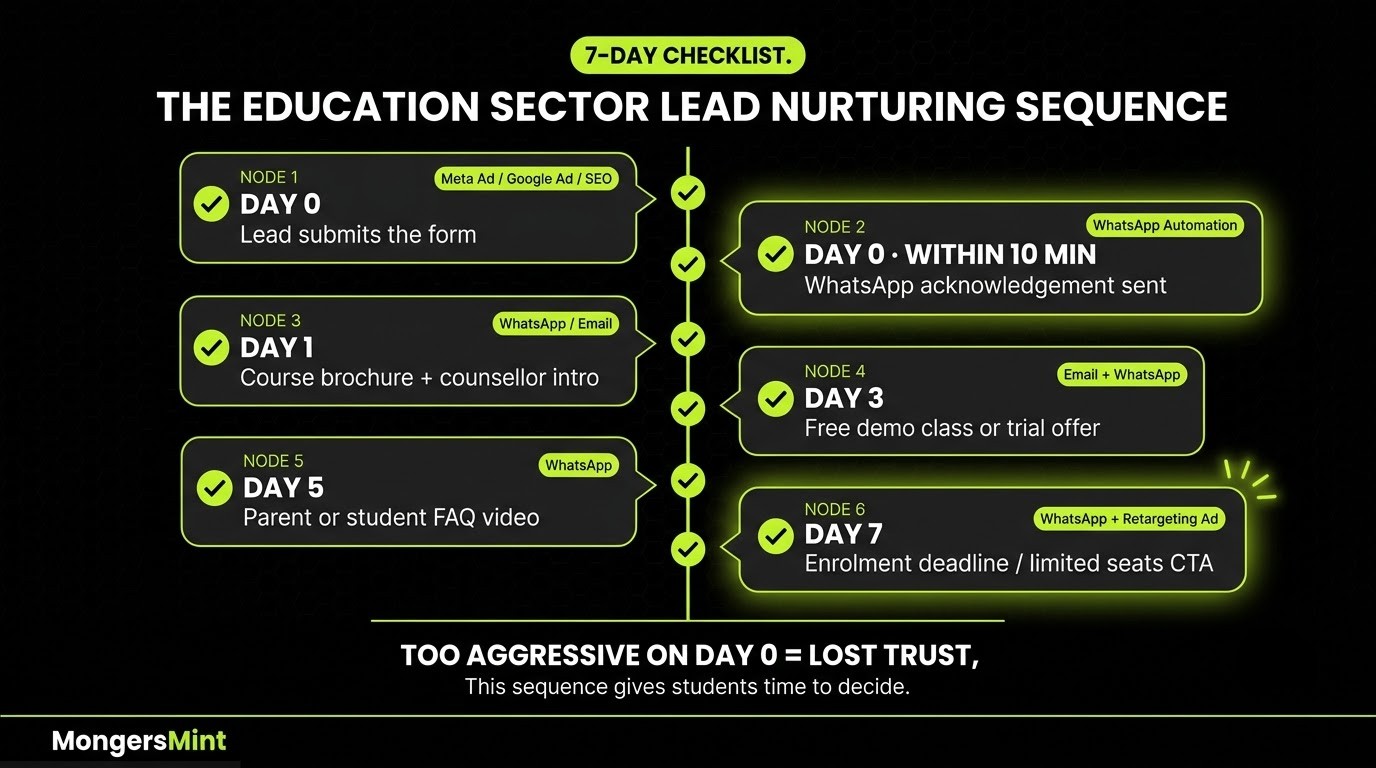
The Education Sector Lead Nurturing Sequence
The journey to enrollment in the education sector is as follows:
| Stage | What Happens | Channel |
| Day 0 | The lead submits the form. | Meta Ad / Google Ad / SEO |
| Day 0 (within 10 mins) | WhatsApp acknowledgement | WhatsApp Automation |
| Day 1 | Course brochure + counsellor intro | WhatsApp / Email |
| Day 3 | Free demo class/trial offer | Email + WhatsApp |
| Day 5 | Parent or student FAQ video | |
| Day 7 | Enrolment deadline or limited seats CTA | WhatsApp + Retargeting Ad |
The Lead Nurturing Sequence for Education by Day is shown in Table 2.
This approach works because it gives students time to make a decision. In education, contacting a lead too aggressively on the first day can quickly cause them to lose interest.
| 💡 Expert Insight — “Education leads are different from B2B leads. The parent who is buying a ₹1.2 lakh course for their kid is emotionally and financially buying at the same time. Sequences which cater to the parent’s fear of wasting money and the student’s excitement of outcomes convert 2-3X more than generic follow-ups on features or deadlines. [Context: MongersMint Campaign Data / Based on 2025 education sector analysis / Senior Digital Strategist] |
What is the Role of CRM for Education Lead Management in 2026?
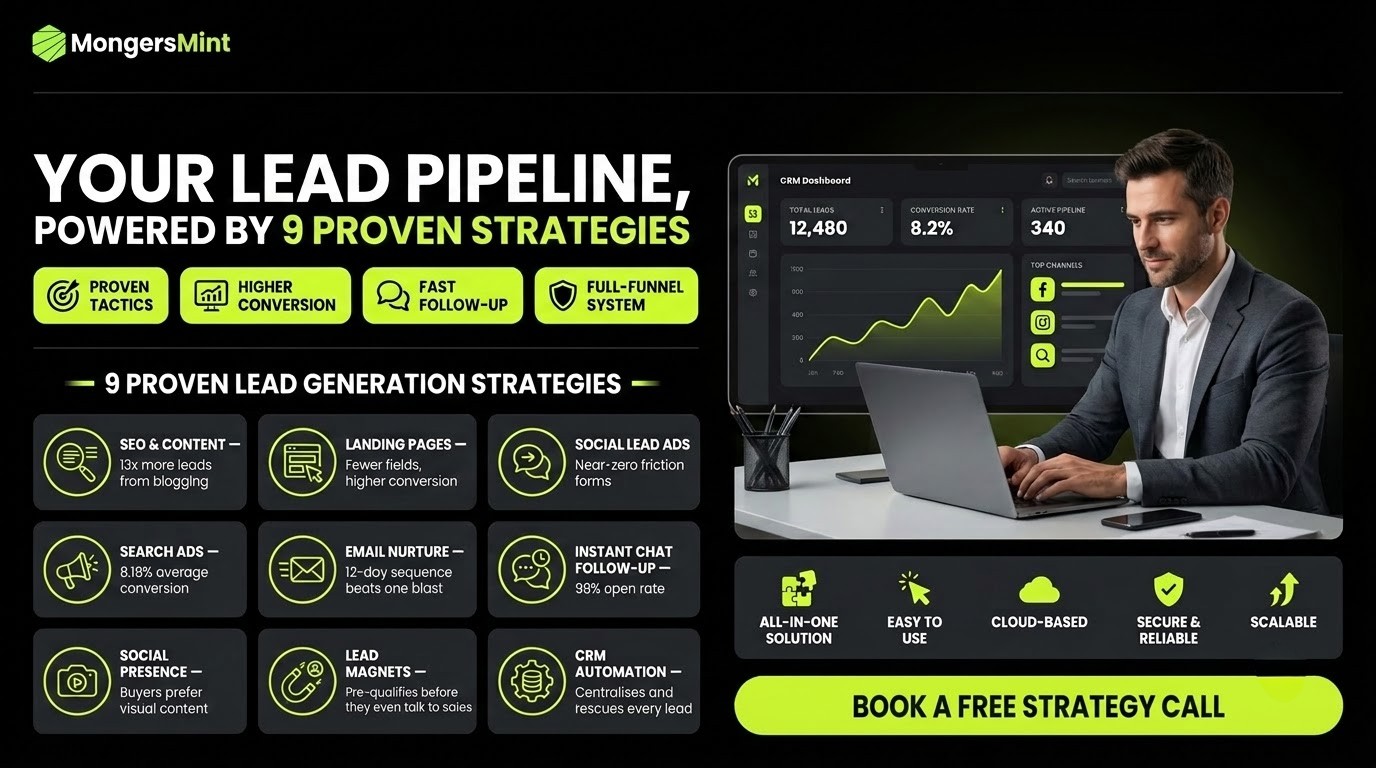
One of the biggest gaps in how to generate leads in the education field from digital marketing is what happens after the lead comes in. Counsellors get busy. Inquiries pile up. Students who inquired about a course 6 days ago are called back 14 days later only to find out that they have already signed up for another course.
An education CRM system for lead management addresses this by:
- Course/location-based lead assignment to counsellors (automatic)
- Setting up WhatsApp and email on submission of the form
- Demonstrating to counsellors where leads are in the process
- Making sure follow-up reminders are set so that no lead is left unattended for longer than 48 hours.
- Monitoring ad campaigns that are actually enrolling, rather than enquiring
Starting a campaign and creating leads is only half the issue. The second is to convert those leads before they turn cold. MongersMint’s platform, called MongersMint SaaS, takes care of both.
As leads flow in from all sources (Meta ads, Google, SEO, landing page, etc.), the platform automatically sends a WhatsApp message, places the contact in a CRM pipeline, and initiates a programmed nurture sequence.
All leads are available on a single platform for counsellors and sales teams to view. It also handles appointment scheduling, AI-powered follow-up calls, and analytics of your campaigns to see which channel is delivering actual revenue and not just form fills.
What Successful Lead Generation Looks Like?
It’s important to have a baseline before wrapping up. Let’s check out the healthy lead generation in digital marketing across the channels:
| Channel | Avg. Cost Per Lead (India) | Lead Quality | Time to Results |
| SEO / Organic | ₹0–₹80 (content cost amortised) | High | 3–6 months |
| Meta Ads | ₹80–₹400 | Medium–High | 1–4 weeks |
| Google Ads | ₹150–₹600 | High (search intent) | 1–3 weeks |
| Email Marketing | ₹10–₹50 | High (warm list) | Ongoing |
| WhatsApp Nurture | ₹5–₹30 | Very High | Immediate |
Table 3 shows the benchmarks for Lead Generation Channel in India (2026).
MongersMint campaign data should be used as benchmarks against which to verify INR, prior to publishing. The top businesses don’t choose just one channel. They work on SEO for organic traffic in the long run, paid ads for quick lead capture, and CRM automation to ensure no stone is left unturned. Create a digital presence that becomes a lead machine for you!
When it comes to how to generate leads in digital marketing, it is all about creating a system, not running campaigns. All of the strategies in this guide are effective. However, they’re more effective when they’re working together, with SEO generating leads, paid ads attracting the right visitors, WhatsApp automation converting leads quickly, and a CRM keeping them alive until they’re ready to close.
Start with 2 channels. Set up a basic follow-up sequence. Weekly, check your cost per lead and conversion rate. After that, add channels as you grow. For businesses that want to have a team build and run this for them, MongersMint has worked with businesses across India to create a full-fledged lead generation system in digital marketing, from the initial ad to the final deal.
FAQs (Frequently Asked Questions)
Q1. Lead Generation in Digital Marketing: What is it?
Lead generation in digital marketing involves attracting leads to your website and capturing their contact information, whether via forms, WhatsApp, landing pages, or social media, and then following up with them to turn them into paying customers.
Q2. How to Get Free Leads in Digital Marketing?
The top free channels are SEO blog content, organic social media, and referrals. A well-optimised blog post that ranks on Google can be used to create consistent lead capture without any ad spend. It takes time to develop, but the effects multiply.
Q3. How to Quickly Create Leads for My Business?
How to generate leads in digital marketing quickly? Paid ads, particularly Meta ads with a lead form and instant WhatsApp follow-up, are the quickest way to do so. If the campaign setup is done well, it can generate leads within 24-48 hours of it going live.
Q4. What's the difference between a lead and a conversion?
A lead is a person who has exhibited interest (filled a form, sent a message, clicked a CTA). When that person takes the next meaningful action, whether it's booking a call, making a purchase, or enrolling, it's a conversion. Conversion rate is defined as the % of leads that convert.
Q5. What are the "how-to"s of lead generation in the education industry?
The most effective approach to educating leads in the education space is a multi-faceted one that involves running a Meta campaign to target both students and parents, a Google Ads campaign to target students who are actively searching for courses, and a nurture sequence on WhatsApp that tackles both of these groups' concerns over 5-7 days.
Q6. How can SEO contribute to lead generation?
SEO attracts organic visitors to your website, who are already looking for what you have to offer. SEO traffic is not like paid traffic in that it can cease once your budget runs out. A well optimised page is constantly making leads – and the leads coming from organic search are of a higher quality because they are the ones that are seeking you out.
Q7. What are the digital marketing lead generation tools?
These are common tools used: Google Ads (Paid Search), Meta Ads Manager (Social Paid Ads), Mailchimp or ActiveCampaign (Email Marketing), WhatsApp Business API (Lead Nurturing), and CRM (Lead Capture, Lead Pipeline Management, Auto Follow-up, Analytics) such as MongersMint SaaS.