What You’ll Learn
|
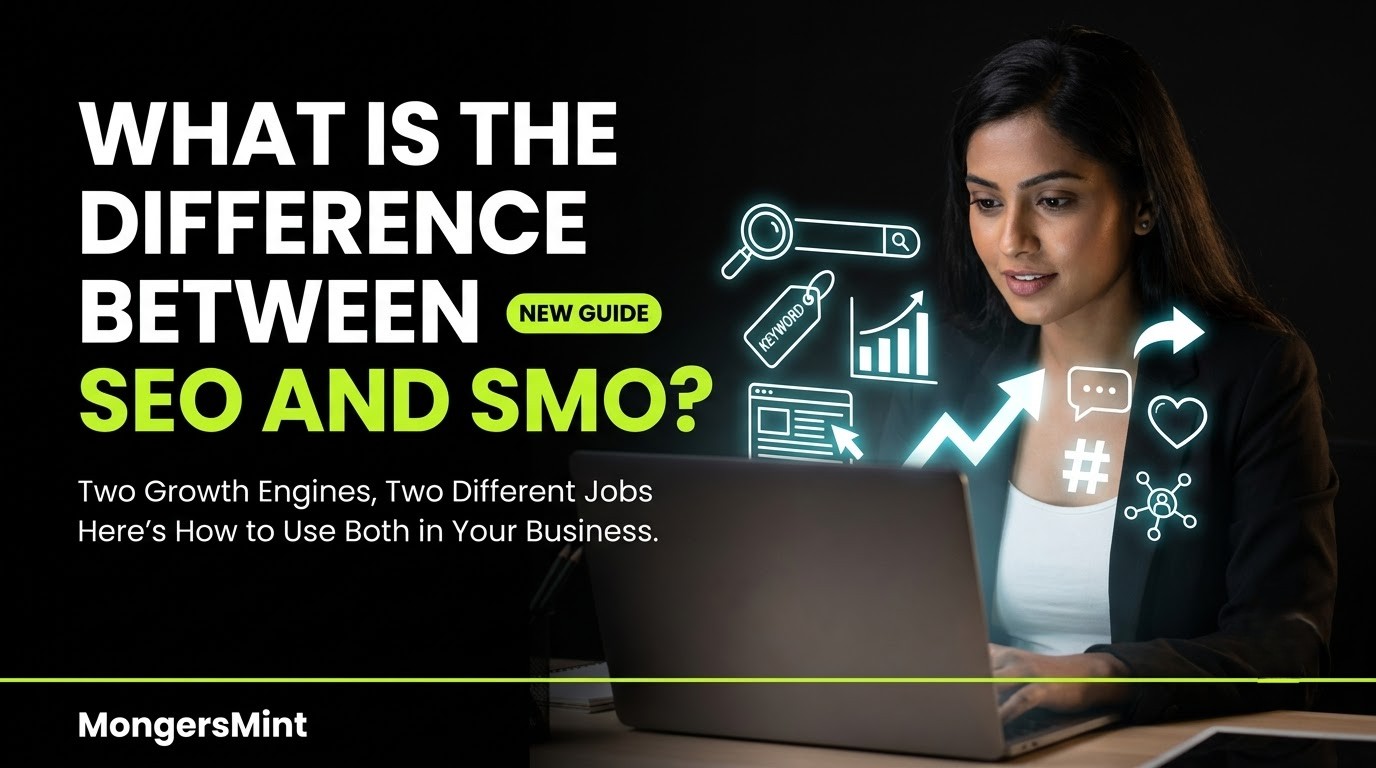
One of the most searched questions in digital marketing is the difference between SEO and SMO, and one of the most poorly answered questions. You’ve created a website. Social profiles are set up. However, leads aren’t flowing in the manner you’d hoped, and someone has thrown around the acronyms of SEO vs SMO, SEM and SMM, and you’re not sure what you need.
The distinction between SEO and SMO is what traffic you are getting, how quickly you get it, and what kind of traffic you are getting. At the end of this article, you’ll be able to determine what each channel does, how they relate to one another, and how to make a savvy decision about where to begin.
The difference between SEO and SMO is quite simple:
You’ve most likely heard about both of them enough times that you know they’re important. However, they are used to address different problems, and mixing them up wastes budget.
What Is SEO?
SEO (search engine optimisation) is the procedure of increasing the ranking of your website on Google and other search engines when someone searches for a particular thing. This includes keyword research, on-page SEO (optimising your titles, headings, and content), off-page SEO (backlinks from other sites), and technical fixes that allow search engines to crawl your pages. Someone types “digital marketing agency in Bengaluru” and SEO will make the difference between your site appearing or not.
What is SMO?
Social media optimisation (SMO) is all about increasing the visibility and shareability of your content on social media channels such as Instagram, LinkedIn, Facebook and YouTube. It includes profile optimisation, social media interaction, and content types that result in sharing and creating a community for your brand. Social consumers aren’t searching for you like they are when searching. SMO places your material in their feed and gets their consideration.
The quickest method to recall the distinction between SEO and SMO: SEO gets individuals to your content. With SMO, you can push your content to the users.
Both attract organic traffic from entirely different sources and with entirely different behaviour.
SEO vs SMO: A Quick Comparison in 2026
| Factor | SEO | SMO |
| Platform | Google, Bing, Yahoo | Instagram, LinkedIn, Facebook, YouTube |
| User intent | High (actively searching) | Low to medium (browsing, discovering) |
| Traffic type | Organic traffic from search | Social referral traffic |
| Time to results | 3–6 months typically | Days to weeks |
| Core tactic | Keyword research, backlinks, and on-page SEO | Content, social media engagement, profile optimisation |
| Primary metric | Rankings, organic traffic | Reach, engagement rate, followers |
| Cost | Time and expertise | Time and content creation |
| Longevity | Long-lasting if maintained | Drops without consistent posting |
What is the Main Difference between SEO and SMO in 2026?
You’re a business owner who sells accounting software for small businesses. Let’s take a look at how the two channels differ from your point of view.
- In SEO, you would develop a well-optimised blog post, “Best Accounting Software for Small Businesses in India,” with a specific keyword in mind and then work on getting backlinks to boost the ranking of that post. If someone types in that phrase, they will come to you. They have a need. That is high-intent organic traffic.
- On Instagram, you would build a carousel, and on LinkedIn, you would make a brief post that says, “5 accounting mistakes small businesses make in their first year.” Your social media involvement is gradually developing. You’re not being sought out by the audience, but the content is valuable; they follow your page, and eventually, they remember your brand when they are in need of software. One pulls. The other pushes.
- There are many people who argue that SEO is more effective than SMO and vice versa. Many people say that SMO is better than SEO and vice versa.
- According to a 2025 industry report, more than 53% of all website traffic is from organic search, and social media platforms account for about 10% of global website traffic.
- The difference between the two is the knowledge of user psychology between SEO and SMO, which makes the difference between a focused digital marketing strategy and scattered efforts. SEO gets in touch with individuals at the moment of intent. SMO is a way of getting in touch with people when they’re in the moment of attention.
What is SMO in Digital Marketing and How is it Different from SEO?
SMO in Digital Marketing: What is it? It is the organic approach to optimising your social profiles, content formats, posting cadence, and hashtag strategy and increasing your reach without paying for ads.
- Most of the people are getting the idea of SMO in digital marketing wrong, as it is the paid side, which is SMM (social media marketing). SEO, SEM, SMO, and SMM are actually a two-axis split: organic vs. paid and search vs. social.
- SEO vs. SMO is on the organic side. Both are channels that are compounding and have zero ad spend. SEM vs SMM is on the paid side; both cease to work when you stop spending money.
- With this in mind, when you’re creating your SEO and SMO strategy, you’re picking your two long-term organic engines and determining the amount of paid assistance you can add to the mix.
- In 2025, a study showed that content marketing with SEO blogs can drive more than 1,000% more traffic than organic social media alone.
- But that does not indicate that SMO is weak. It simply implies that they cater to different phases of the buyer’s journey, and a good SEO and SMO strategy incorporates both of them.
- SEO, SEM, SMO, and SMM are all distinct marketing strategies, each with its own unique focus and methods. SEO, SEM, SMO, and SMM are different marketing strategies, each having a different focus and approach.
Explore: Best Web Development Services That Drive Real Growth
What is the Difference Between SEO, SEM, SMO, and SMM? A Complete Breakdown in 2026
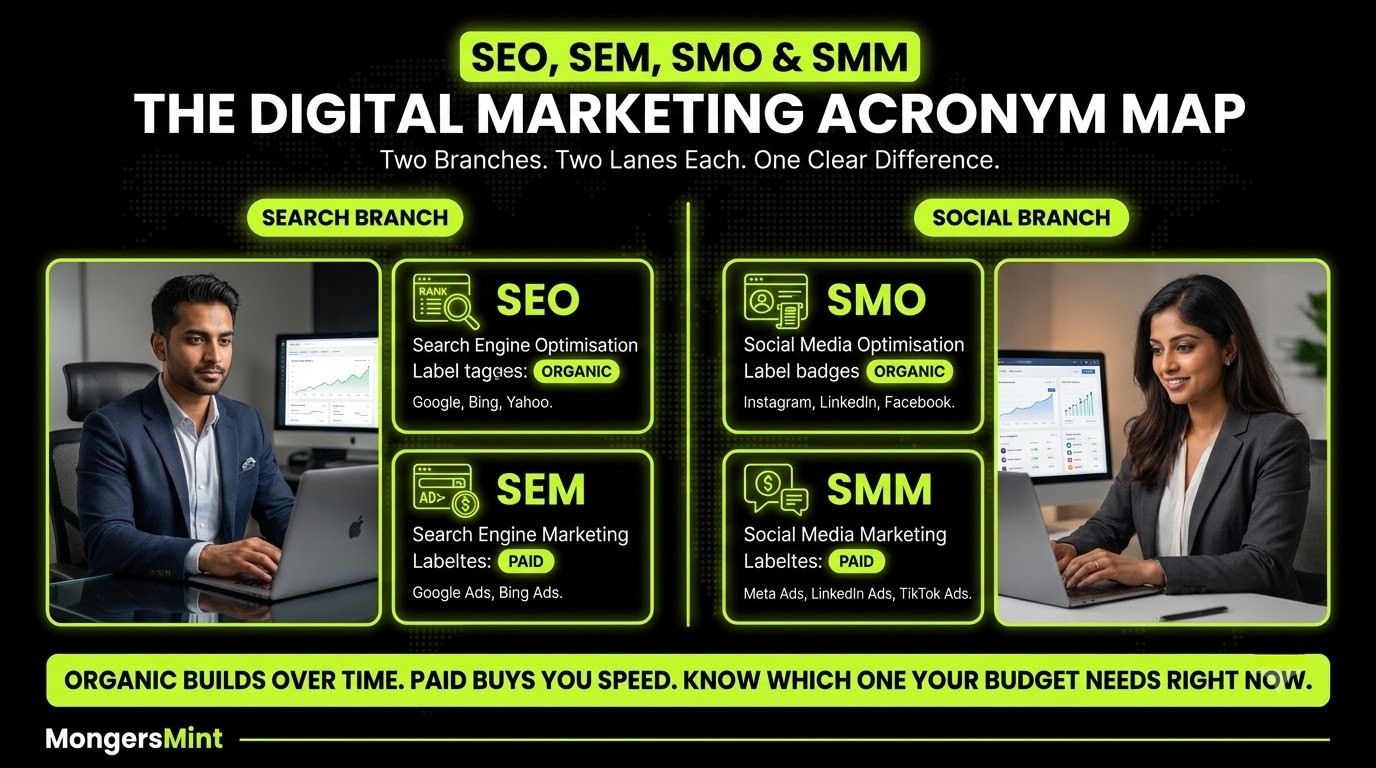
This is where most get caught up. All four acronyms fall under the umbrella of digital marketing but are not synonymous. Here’s the map.
- Consider it as 2 branches: Search and Social. There is an organic lane and a paid lane in each branch.
- The search branch will provide you with SEO (organic search ranking without paid advertising) and SEM (paid search buying ad placements on Google through PPC).
- The social branch offers you SMO (organic social growing reach through content marketing and profile optimisation) and SMM (Social Media Marketing), which is paid social (sponsored ads on Meta, LinkedIn, Instagram, and so on).
- In simple terms, SEO and SMO are organic strategies that take time and effort, while SEM and SMM use paid advertising to get faster results. PPC is a payment method used for paid search and social ads, not a separate marketing channel.
[INFOGRAPHIC: The Digital Marketing Acronym Map]
| Term | Stands For | Organic or Paid | Where It Works |
| SEO | Search Engine Optimisation | Organic | Google, Bing, Yahoo |
| SEM | Search Engine Marketing | Paid | Google Ads, Bing Ads |
| SMO | Social Media Optimisation | Organic | Instagram, LinkedIn, Facebook |
| SMM | Social Media Marketing | Paid | Meta Ads, LinkedIn Ads, TikTok Ads |
Another aspect that is crucial for SEO, SEM, SMO, and SMM is the difference between them, which is also important for budget planning. The long-term organic plays are SEO and SMO. SEM and SMM are quicker, but they cease as soon as you run out of funds for paid advertising.
| 💡 Expert Insight — “By 2025, the line between SEO and SMO is not as distinct as most marketers would think. Google’s AI Overviews are now incorporating content from platforms like Reddit, YouTube, and LinkedIn, which are optimised for SMO, into search results. A brand that only monitors Google rankings is missing out on 20–36% of visibility that its competitors are enjoying from social content that is being indexed by search engines.” |
How SEO and SMO Differ in Generating Traffic in 2026?
While both the channels generate organic traffic, knowing the difference between SEO and SMO mechanics and the psychology of the audience makes the strategy work.
SEO Mechanics: Relevance Signals
1. Keyword Research: Identify what people are searching for.
Relevance signals are how search engine optimisation works. You research keywords and find out what people are searching for, you write content that is better than any other site on the web, you get backlinks from other sites, and you correct technical problems that slow down your site.
2. Content Creation: Write content that is better than any other site on the web.
Those signals are read by Google’s algorithm, and that determines where you rank. That ranking is maintained by a strong on-page SEO structure, clear headings, fast load times, and mobile-friendly pages. Off-page SEO viaGoogle thinkklinks from reputable websites makes GooOptimisationat your content trustworthy.
3. Technical Optimisation:
Correct technical issues that slow down your site.
4. Maintenance
Maintain ranking through strong on-page SEO structures, clear headings, fast load times, and mobile-friendly pages. Off-page SEO via high-quality backlinks makes Google think your content is trustworthy.
SMO Mechanics: Engagement Signals
Social media optimisation is done on the basis of engagement signals. You make your profile optimised to be found via the platform search. You produce content that breaks the scroll: short-form videos, infographics, carousel posts, and more that help build social media engagement.
- Profile Optimisation: Make your profile optimised to be found via platform search.
- Content Production: Produce scroll-stopping content such as short-form videos, infographics, and carousel posts to build engagement.
- Platform Interaction: The more you interact with the platform at the beginning, the more your content will be shown to others.
- Time Sensitivity: Content should be used within a short period of time, as a good-performing post is often lost by Friday.
Let’s look at the difference between SMO and SEO in greater detail:
| Dimension | SEO | SMO |
| Audience mindset | Searching with intent | Browsing passively |
| Content format | Blog posts, landing pages, guides | Reels, carousels, stories, short videos |
| Algorithm | Search engine crawlers + ranking signals | Platform engagement signals |
| Key tactics | Keyword research, on-page SEO, off-page SEO, backlinks | Profile optimisation, content marketing, social media engagement |
| Compounding effect | High pages rank longer over time | Low content decays fast |
| Community building | Low direct community | High direct follower relationship |
| Brand awareness | Builds through consistent rankings | Builds faster through viral and social signals |
| B2B strength | Very strong (high-intent buyers search) | Strong on LinkedIn specifically |
According to a 2025 industry report, SEO leads are 14.6% while outbound leads are 1.7%, meaning that SEO leads are of much higher quality when it comes to conversion.
The difference between SEO and SMO in time is also very important. SEO is not likely to produce any significant results before 3 months. If the content is relevant, SMO can place you in front of 10,000 people this week.
How Do SEO and SMO Go Hand in Hand to Boost Each Other in 2026?
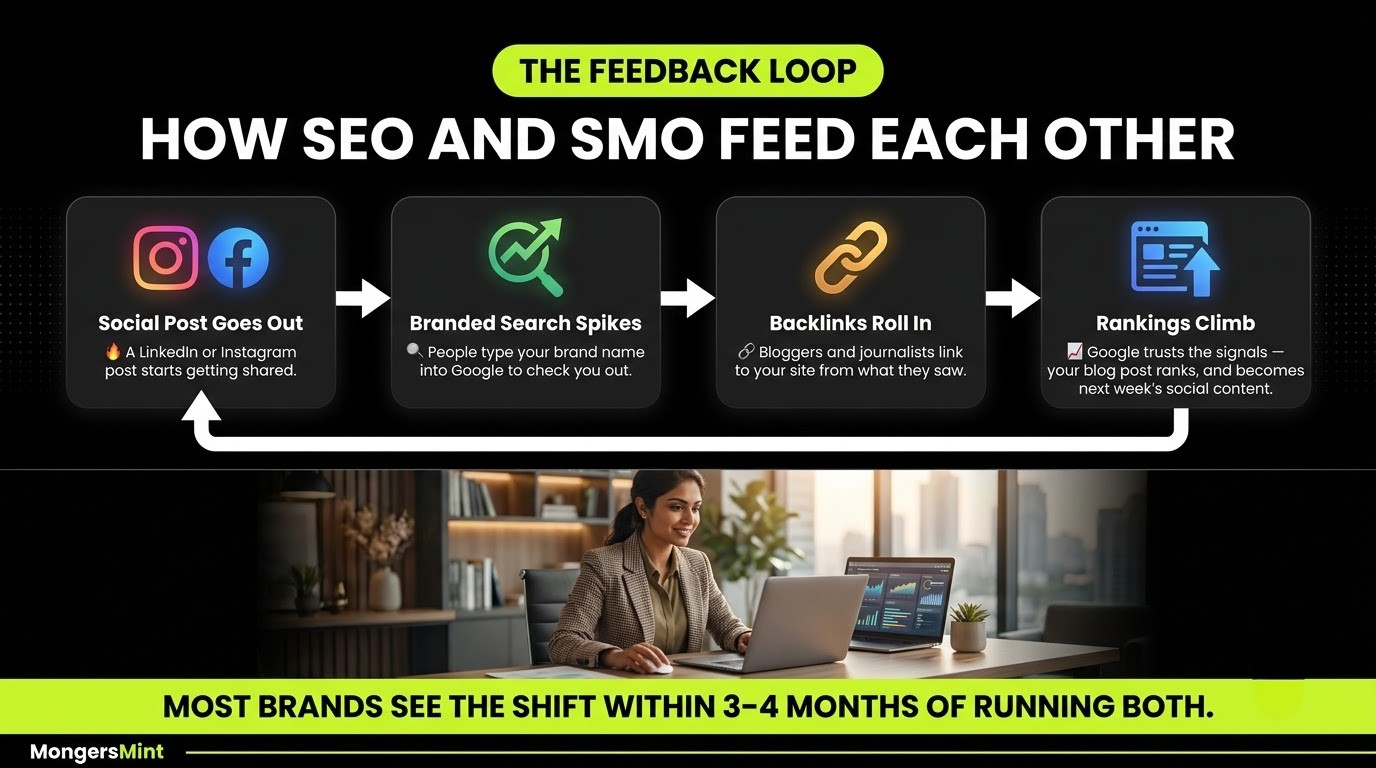
When it comes to budget, most of the businesses consider SEO and SMO as two different things, and they think they are competing. That’s framing it so that they lose out on traffic for free.
SMO as an Indirect SEO Driver
- SMO is an indirect SEO driver. As your social content is shared around, people type your brand name into Google.
- Those social signals, namely, branded search volume increasing and traffic spiking from social referral, are telling Google that your brand is worth ranking.
- Some of the journalists or bloggers who see your viral LinkedIn post link to your site. Those backlinks will directly help you to boost your search engine optimisation. The impact of SEO and SMO, when used separately and together, can be seen in most businesses within 3-4 months.
SEO Feeding SMO
SEO feeds SMO. If you’re ranking on Google, then your best social content is a blog post. It’s got a proven headline and a proven topic, and it provides you with weeks of content marketing that you can use:
- Pull out a stat and use it for a LinkedIn post.
- Use a section to create an Instagram carousel.
- Create a 60-minute video reviewing the main points.
The Feedback Loop: Sequencing SEO and SMO
If your audience is finding you on social and then Googling your brand to make sure that you’re legit, both are working. It’s not a matter of which to run; it’s a matter of how to sequence them. Where most businesses begin to see the difference between SEO and SMO is in the same month when they start to see the sequencing.
Case Study: E-commerce Strategy
This was tried by one e-commerce brand for more than 6 months. They created product guides that are optimised for SEO, and at the same time, they shared snippets on Instagram and LinkedIn. The results included:
- The number of visitors from search engines increased by 34%.
- The SMO activity also helped to increase the brand awareness metrics; branded search volume increased by 22%, thus improving Google’s confidence in the site.
- Indirect ranking factor: Social signals from SMO.
Leveraging MongersMint Growth Suite for Amplifying Efforts With Proven Systems
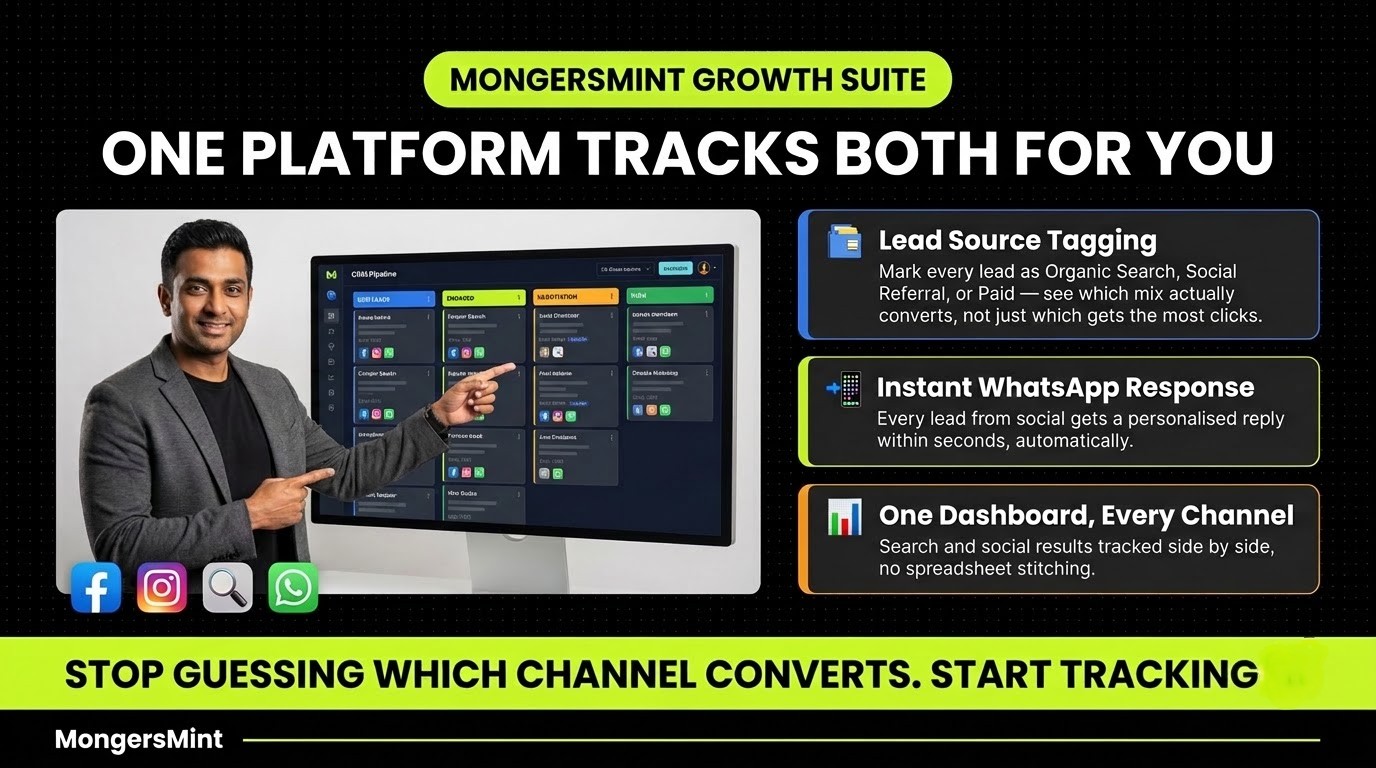
That’s where MongersMint’s platform is useful for growing teams, as it helps to manage that integration, track leads from both search and social, and helps to keep follow-ups from falling through the cracks.
- With the CRM pipeline, you can mark the source of your leads (organic search, social referral, or paid) and finally find out which mix of these leads is the most converting, not just the most traffic.
- WhatsApp automation is integrated, and each lead from social is responded to within seconds and is personalised. Speak with the MongersMint team concerning the built-in SEO and social media marketing strategy.
| 💡 Expert Insight—”Most brands will have separate dashboards for SEO and SMO and will never see the feedback loop between these two—track the branded search volume in Google Search Console and see the social reach. When you see branded search volume increasing 2-3 weeks after a strong social campaign, you know they are amplifying each other, and that’s the data that gets you cross-channel budget approval. [Context: Senior Digital Strategist / MongersMint Campaign Data] |
How to Choose the Channel to Focus on When it Comes to SEO and SMO?
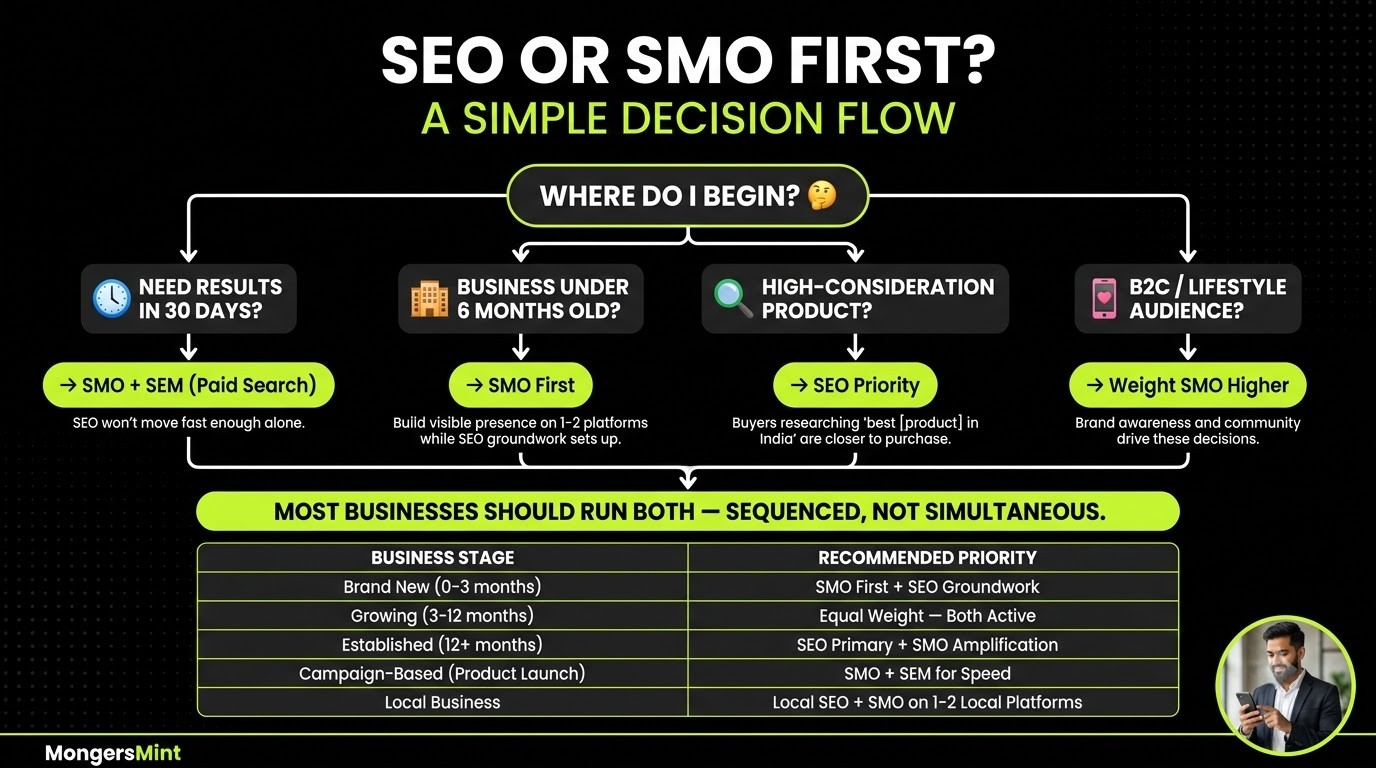 It’s not really about which is better. It is the question of “Where do I begin? Where am I at? You should ask this before spending a rupee in your digital marketing plan.
There are 4 factors that will determine your answer:
- Time
- Money
- Age of business
- Audience behaviour (social vs. search)
Let’s take a down-to-earth approach. Solve each of these problems:
- Looking for results in 30 days or less? If so, begin by using SMO for organic reach and paid search placements with SEM. SEO will not do so much in a very short period of time.
- Does your company have less than 6 months of experience? SMO creates a presence that can be seen more quickly. Join 1-2 social media sites where your audience hangs out, post regularly, and develop an audience while you lay the groundwork for your SEO.
- Have a high-consideration product that requires research prior to purchase? Prioritise SEO. If the buyer types the “best [product] in India,” then he is much closer to buying than someone who randomly lands on your Instagram post.
- Do you have a social audience (B2C, fashion, food, fitness, lifestyle)? Weight SMO higher. It’s in brand awareness and community where the decision is made in those categories.
[INFOGRAPHIC] SEO or SMO First? Decision Flowchart: A Simple Decision Flow
The answer is to run both, but sequence them, for most businesses. Use SMO in the beginning to get your brand noticed as your SEO increases. When your search rankings begin to take effect, use your content marketing that is optimised for search as the fuel for your social channels.
| Business Stage | Recommended Priority |
| Brand new (0–3 months) | SMO first + SEO groundwork |
| Growing (3–12 months) | Equal weight—both active |
| Established (12+ months) | SEO as primary + SMO for amplification |
| Campaign-based (product launch) | SMO + SEM for speed |
| Local business | Local SEO + SMO on 1–2 local-relevant platforms |
How does SEO vs. SMO impact your approach in 2026?
There have been changes in the landscape in the last 2 years, and some of the older ideas about SMO vs. SEO don’t apply anymore.
- Google’s AI Overviews are integrating content from LinkedIn posts, Reddit threads, and YouTube videos, all of which are social media platforms that are well optimised by SMO. According to the analysis carried out by SE Ranking, social media platforms were present in the AI Overview results for 20% of queries and for 36% of queries in AI Mode.
- It means that your SMO content can now be seen in Google search results without having to do any traditional on-page SEO optimisation. While SEO and SMO are still different, the distinction between the two is closing at the top of the funnel.
- Meanwhile, there are more than 5.66 billion social media users worldwide, and a business that doesn’t leverage SMO in digital marketing is missing out on a huge market.
- SEO and SMO are still different; they are different in terms of their working methods, different in terms of the behaviour of the users, and different in terms of the content that is required. However, the brands that are succeeding in 2026 are not considering them to be mutually exclusive options. They’re creating a digital marketing plan that is geared towards building links and ranking in search engines, then building on that content with SMO to push it out through social media, boost social signals, and capture buyers at every point of the funnel.
The Smart Approach of Allocation of Budget and Effort Between SEO and SMO in 2026
You likely don’t have an unlimited amount of time or money to work with. Therefore, let’s get down to brass tacks on your SEO and SMO plan.
- If you are a small content team with 1-2 people and a small marketing budget, divide your efforts about 60/40 between SEO and marketing for the first year. SEO compounds. A blog post that’s based on solid keyword research and good off-page SEO in month 3 can continue to generate leads in year 2. Social content does not carry over the same.
- If you’re in a category where buying decisions are made on social media platforms, such as fashion, food, events, fitness, local services, D2C brands, increase that to 60/40 in favour of SMO. Prior to even reaching Google, your buyers are browsing Instagram or YouTube. When they search, they will consider you, because you are in their brand awareness set, created by SMO.
- For B2B companies that are looking to reach decision makers, LinkedIn-specific SMO combined with good search engine optimisation is always going to beat either SMO or search engine optimisation alone. Social signals from LinkedIn activity can be measured to affect branded search volume, and branded search is a great ranking signal for competitive B2B keywords.
- Measure both wherever you fall on that split. Organic traffic on Google Search Console. Social media interactions based on the analytics of your platform. The gap between the two is branded search volume. The difference between SEO and SMO is not a problem anymore when all 3 work together; it’s an asset, and your channels are working as a system.
MongersMint’s SEO services are tailored in this manner of thinking. Instead of optimising pages individually, the team integrates keyword research with your content calendar, monitors the impact of SMO on branded search, and makes monthly changes to your digital marketing strategy based on the data. In case you’re determining the correct blend of SEO vs. SMO for your particular business, explore MongersMint’s SEO services.
Understanding the Difference Between SEO and SMO and Making it Work For You in 2026
Core Integration Principles
- SEO and SMO are not the same, and it does make a difference, but there was never a question of choosing one.
- The base is laid with search engine optimisation.
- Social media optimisation is the way to develop the audience.
- Content marketing is what binds them together.
- But it’s a clear digital marketing strategy that monitors organic traffic, social signals, and brand awareness in both that makes that combination into compounding growth.
Action Plan for Success
- Begin by having a clear idea of the behaviour of your audience.
- Determine if they’re searching or scrolling when they first come across your category.
- Develop your SEO and SMO strategy based on that and monitor the feedback loop between them.
If you need some assistance in auditing your current SEO and SMO performance and determining the balance for your business, the MongersMint team is available to assist you.
Conclusion
SEO and SMO serve different purposes, but the best digital marketing strategy uses both. SEO helps you attract people who are actively searching for your products or services, while SMO helps you build visibility, engagement, and brand awareness on social platforms. Instead of treating SEO vs. SMO as a choice, businesses can use SEO for long-term organic growth and SMO to expand their reach and connect with their audience.
The right balance depends on your business goals, audience, budget, and how quickly you need results. By combining search-focused content with consistent social media optimisation, you can reach customers at different stages of their journey and build a stronger online presence. If you need help creating the right SEO and SMO strategy for your business, MongersMint can help you plan, optimise, and manage both channels for sustainable growth.
FAQ (Frequently Asked Questions)
Q1. What is the difference between SEO and SMO in digital marketing?
The only difference between SEO and SMO is where content is found. SEO makes your website visible on search engines such as Google by using keyword research, on-page, off-page, and backlink strategies. SMO enhances your visibility and social media involvement on platforms, for example, Instagram, LinkedIn, and Facebook. SEO is for people who are actively searching. SMO is geared towards passive browsers.
Q2. Is SMO a part of SEO?
No, SMO and SEO are two different fields and have different platforms and mechanics. SMO is about social media and social signals, and SEO is about search engines and organic traffic. They work together but are not mutually exclusive; strong SMO can create backlinks and branded search volume, which can have indirect positive impacts on SEO.
Q3. What is the Difference between SEO, SEM, SMO and SMM
The difference between SEO, SEM, SMO, and SMM is based on two axis: organic vs paid and search vs social. SEO is search that is not paid for. SEM is paid search (Google Ads). SMO is organic social. SMM is paid social (paid advertising on Meta, LinkedIn, and TikTok). SEO, as well as SMO, develops long-term organic traffic. SEM and SMM provide quicker outcomes and cease when the budget runs out.
Q4. So, SEO or SMO—Which is Better for a Small Business?
This will depend on your time frame and target audience. SMO helps you to become visible quicker and create brand awareness and community. SEO is slower but yields higher-intent organic traffic that has a higher conversion rate. Most small businesses should have both of them; SMO as the long-term foundation and small business marketing as its early presence.
Q5. Social Media and SEO are a Match Made in Heaven?
Not directly. Likes and shares will not affect your ranking in Google. Social signals help indirectly, though, because the more people engage with your brand on social media, the more branded search you will get, the more opportunities for backlinks if your content goes viral, and the more traffic you will get, which will indicate relevance to search engines.
Q6. How Long Does SEO Take as Compared to SMO?
Generally, SEO takes 3 – 6 months to start seeing any significant results, as keyword research, on-page SEO, and off-page SEO all take time to compound. With strong content, SMO can help your website get social media engagement and traffic within days of the posting. However, SMO results fade out rapidly as compared to solid backlinks and content marketing that build up over time and have SEO results.
Q7. Can I Run SEO and SMO at The Same Time?
Yes, and you are encouraged to do so! Both of them can be performed concurrently to realise immediate gains from social media and to wait for the search engine optimisation to take effect. It's also possible to use your very best SEO content as a content marketing strategy on social media, which will help to save you time and strengthen both strategies.